
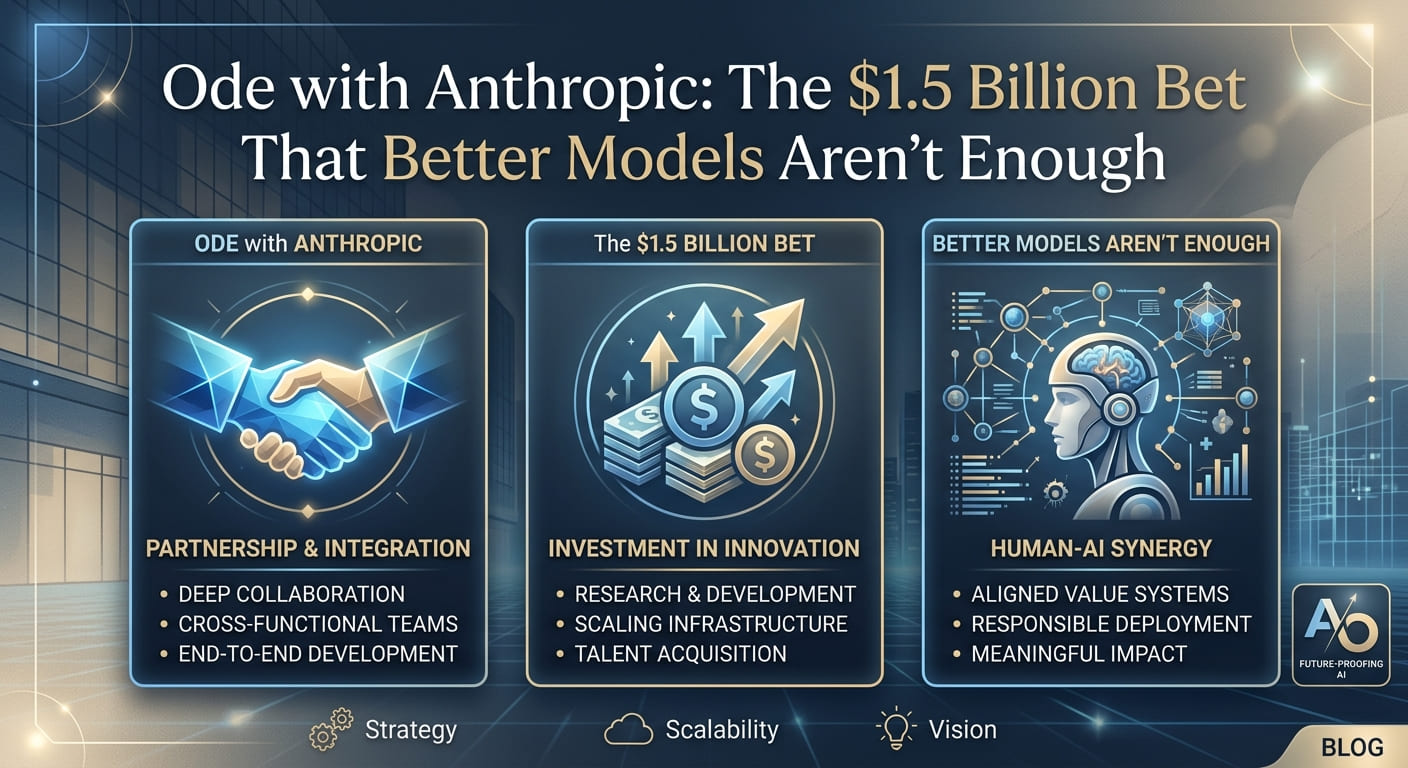
Building a smart AI model is one thing. Getting a large company to actually use it is another. Anthropic has decided the second part is where the real money is.
That decision has a name now: Ode with Anthropic. It’s a $1.5 billion AI implementation company launched in May, and its whole job is to help businesses put AI to work in their day-to-day operations.
Here is what Ode does, who is behind it, and why one of the biggest names in AI thinks this is the next huge market.
What Ode Actually Is
Start with a plain definition. Ode is an AI services firm that sends engineers into companies to build AI systems that fit how those companies already run.
Think of it like hiring a contractor to renovate your kitchen. You do not need to know how to install cabinets yourself. You bring in people who do the work and leave you with something that fits your space. Ode does that, but for AI inside a business.
The company launched as a $1.5 billion joint venture. Anthropic is the AI partner. The financial muscle comes from an Anthropic Blackstone partnership, along with Hellman & Friedman, Goldman Sachs, and others.
That backing matters. A boutique AI firm with that much money behind it can grow fast and take on the largest clients in the world.
Ode currently employs 100 engineers. It works hand in hand with Anthropic’s applied AI team to spot where the technology can make a real difference for each business.
Want the short version? Ode is the crew that installs AI for companies that want it but don’t know how to build it themselves.
Why This Matters for Enterprise AI Adoption
Here is the honest problem the whole industry keeps running into. A powerful model does not automatically make a company better. Someone has to wire it into real work.
Most businesses don’t have that skill in-house. They have accountants, marketers, and managers, not AI engineers for businesses. So the model sits there, impressive but unused.
Anthropic saw this gap and built a company to fill it. The bet behind Ode is simple: enterprise AI adoption depends less on the model and more on the installation.
Chris Taylor, Ode’s CEO, put the ambition in blunt terms. He told TechCrunch it’s “pretty easy to imagine this as a trillion-dollar company someday if we execute well.” He also named the hard part: growing fast without letting quality slip.
That tension runs through everything.
The Startup at the Center: Fractional AI
Ode did not start from scratch. It was built on top of an existing company.
The story starts with Blackstone. The firm had been bringing in big consulting names and small AI shops to roll out AI across its portfolio companies. One small shop stood out: an AI engineering startup called Fractional AI.
Shortly after the venture was announced, it made the Fractional AI acquisition official. Fractional became the foundation of what is now Ode—a kind of “scaled boutique” built to keep small-firm quality at large-firm size.
There’s a notable detail in that deal. Fractional ended an 11-month partnership with OpenAI when it was acquired. In other words, it switched camps.
The two people who built Fractional now run Ode. Chris Taylor serves as CEO. Eddie Siegel is the chief technologist. Both co-founded Fractional before it became the core of this new AI services firm. Ode is trying to do. Scale big. Stay sharp.
If you run a business, the takeaway is clear. Buying an AI tool is not the finish line. Ask yourself who will actually build it into your workflow before you sign up for anything.
The Startup at the Center: Fractional AI
Ode did not start from scratch. It was built on top of an existing company.
The story starts with Blackstone. The firm had been bringing in big consulting names and small AI shops to roll out AI across its portfolio companies. One small shop stood out: an AI engineering startup called Fractional AI.
Shortly after the venture was announced, it made the Fractional AI acquisition official. Fractional became the foundation of what is now Ode—a
The Claude-First Strategy, Explained
Ode runs on what it calls a Claude-first strategy. Here’s what that means in plain terms.
When Ode builds a solution, it reaches for Anthropic’s tools first. That includes features like Claude Tag in Slack, which lets teams pull Anthropic’s AI directly into their everyday chats.
But Claude-first is not Claude-only. This is worth stating plainly. Ode will use rival AI products when a job calls for it. The company is not locked into one toolkit.
That flexibility says something about how Ode sees the work. To them, picking the model is a small part of the job.
Eddie Siegel described it with a comparison any builder would recognize. Choosing a model, he said, is like choosing a programming language when you build software. It’s one ingredient in a much bigger system that has to be engineered. You would not judge a whole business overhaul by whether the team picked Python or Java.
Here’s the practical lesson. Do not obsess over which AI model a vendor uses. Ask instead how well they can build the full system around it.
What Ode Sells: Custom AI Solutions, Not Off-the-Shelf Tools
Ode is not selling a product you download. It sells custom AI solutions built for one company at a time.
Siegel says the venture’s real edge is the quality of the build and its ability to solve specific business problems. The model is the easy part. The engineering around it is where most of the effort goes.
Taylor frames the mission around who wins in this era. His founding belief is that ordinary, non-AI companies could be among the biggest winners of this whole moment—but only if they adopt the technology the right way.
That “right way” is the catch. Taking AI, which Taylor called “this magic, hallucinating ingredient,” and rewiring a core business process with it takes serious help. Most companies simply don’t have top-caliber applied AI talent sitting around.
So who is the ideal Ode customer? A company whose CEO already believes.
Taylor was specific here. A lot of Ode’s work is the top one or two priorities for the CEO. It’s the most important feature the company will build over the next two years, or a rebuild of its most important business process.
If you’re weighing an AI overhaul, start at the top. Get real buy-in from leadership before you commit budget, because these projects only work when the CEO treats them as a priority.
The Team: A Small Squad of “Grown-Up” Engineers
Ode describes its people as elite generalist engineers. More than half are former founders.
That’s a deliberate choice. Siegel wants people who can juggle a hard technical problem and also own a project end to end. One Blackstone executive summed it up with a military image: not an army of forward-deployed engineers, but a small unit of “special forces.”
Here’s a quick definition, since the term keeps coming up. Forward-deployed engineers are technical staff sent to work directly inside a client’s business, rather than from a distant office. They sit close to the real problem.
Demand for these teams far outstrips supply, according to people involved in the venture. That’s the heart of the challenge Ode faces next.
The Hard Part: An AI Talent Shortage
Now the honest caveat. Ode’s whole model depends on rare people, and rare people are hard to find.
An elite applied AI engineer, by Ode’s definition, needs several skills at once:
- Real experience as an entrepreneur.
- Systems-first thinking.
- Genuine AI ability.
- Enterprise product judgment.
Finding one person with all four is tough. Finding hundreds is tougher. That’s the AI talent shortage in a sentence, and it’s the biggest question mark hanging over Ode’s plan to scale internationally.
Siegel isn’t losing sleep over it. He argues it has never been easier to become an entrepreneur and that founders learn exactly the skills Ode needs by trying to find product-market fit and move a real business forward. That kind of end-to-end experience, he says, fits Ode perfectly.
Whether enough of those people show up is still an open question. This is not a guarantee. Ode’s growth depends on training or attracting talent faster than the market can drain it.
If you’re an engineer wondering where this field is heading, note the pattern. The valued skill is no longer just coding. It’s owning a whole problem from start to finish. Build that muscle now.
The Competition Is Already Crowded
Ode is not alone in this race. Far from it.
Anthropic’s move follows a similar play by its biggest rival. OpenAI built its own version, called The Deployment Company, on the same idea: winning enterprise customers takes more than shipping better models.
And the frontier labs are not the only players. The old guard of consulting has moved in too. Both Deloitte AI teams and Accenture AI teams have built their own forward-deployed groups to install AI for clients.
So Ode is fighting on two fronts at once:
- Against other AI labs like OpenAI’s The Deployment Company.
- Against consulting giants like Deloitte and Accenture.
That’s a lot of competition for a company that only just got its name. But the size of the prize explains why everyone is rushing in.
If you’re shopping for help with an AI rollout, this competition works in your favor. Compare at least two of these options before you choose, and judge them on the quality of their builds, not the size of their brand. kind of “scaled boutique” built to keep small-firm quality at large-firm size.
There’s a notable detail in that deal. Fractional ended an 11-month partnership with OpenAI when it was acquired. In other words, it switched camps.
The two people who built Fractional now run Ode. Chris Taylor serves as CEO. Eddie Siegel is the chief technologist. Both co-founded Fractional before it became the core of this new AI services firm.
Why the Whole Thing Matters
Step back and the bigger picture comes into focus. For years, the AI race was about who could build the smartest model. Ode is a bet that the next race is different.
The new contest is about who can actually put those models to work inside real companies. That’s a shift from raw capability to practical delivery.
Here’s what it means for you, whether you run a business or just watch the industry. The winners of this phase may not be the labs with the flashiest demos. They may be the ones who can quietly install AI where it earns its keep.
Anthropic clearly believes that. It put $1.5 billion behind the idea, brought in Wall Street backers, and bought a startup that had been working with its top rival.
The result is Ode with Anthropic—an AI implementation company built on the premise that a great model is only half the job. The other half is getting it used.
Keep an eye on this space over the next two years. Watch whether Ode can grow its team without losing quality. That single question will tell you whether the bet pays off.
Frequently Asked Questions
1. What is Ode with Anthropic?
Ode is a $1.5 billion AI implementation company launched in May. It’s an AI services firm that sends engineers into businesses to build custom AI systems tailored to how each company operates. Anthropic is the AI partner, with financial backing from Blackstone, Hellman & Friedman, Goldman Sachs, and others.
2. How is Ode connected to Fractional AI?
Ode was built on the Fractional AI acquisition. Fractional was a small AI engineering startup that stood out while working on Blackstone’s portfolio companies. The joint venture acquired it and made it Ode’s foundation. Fractional ended an 11-month partnership with OpenAI when the deal closed. Its co-founders, Chris Taylor and Eddie Siegel, now lead Ode as CEO and chief technologist.
3. What does “Claude-first strategy” mean?
It means Ode reaches for Anthropic’s tools first when building solutions, including features like Claude Tag in Slack. But Claude-first is not Claude-only. Ode will use rival AI products when a project needs them. The team treats model choice as one small ingredient in a larger engineered system.
4. Who is Ode’s ideal customer?
A company whose CEO already believes in the project. Taylor says much of Ode’s work is the top one or two priorities for a client’s CEO—either the most important feature the company will build over the next two years or a rebuild of its most important business process. Leadership buy-in is the key requirement.
5. Who does Ode compete with?
Ode faces competition on two fronts. Other AI labs, most notably OpenAI’s The Deployment Company, offer similar services. So do consulting giants, with both Deloitte AI teams and Accenture AI teams building their own forward-deployed engineer groups. All are chasing the same goal: helping large companies actually adopt AI.



Be First to Comment