


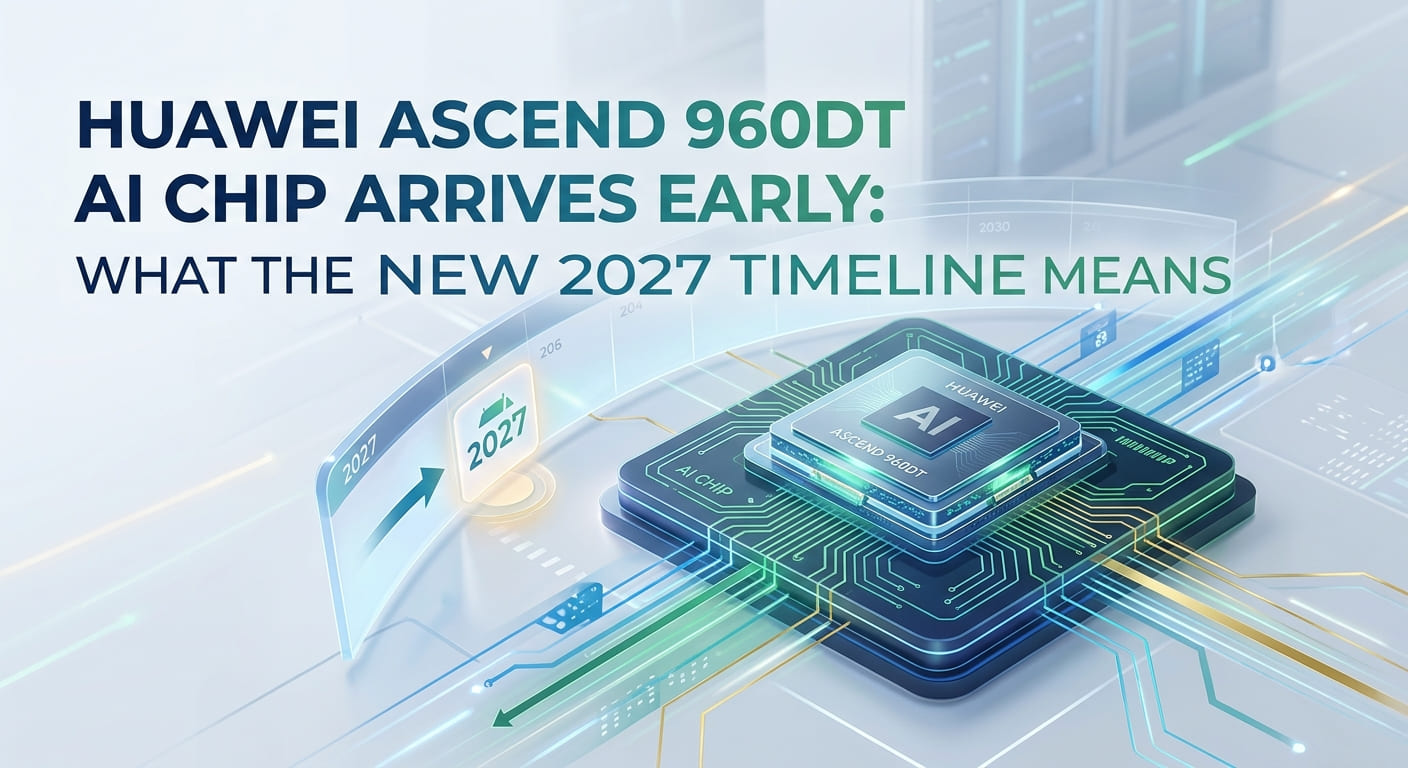
Huawei is speeding up. The company’s next AI chip, the Ascend 960DT, is now due in the first quarter of 2027.
That is earlier than planned. The original target was the third quarter of 2027, so Huawei just pulled the date forward by roughly half a year.
The news came Thursday at Huawei Connect, the company’s own conference. David Wang, Huawei’s rotating and acting chairman, announced the new timeline on stage.
Here is what the chip is, how Huawei’s bigger system works, and why the timing matters far beyond one product. We will define the technical terms as we go, so you do not need a hardware background to follow along.
What the Ascend 960DT Actually Is
Start with the plain version. The Ascend 960DT is an AI chip, the kind of processor built to run artificial intelligence.
You do not need to understand chip design to grasp why this matters, in the same way you do not need to understand engine parts to know a faster car is coming. What matters is speed, timing, and who makes it.
Huawei’s pitch is direct. The company says its Ascend 960 chips are arriving ahead of schedule and doubling in performance year by year. “Doubling performance” simply means each new version does roughly twice the work of the one before it.
The target here is clear too. Huawei is racing to challenge Nvidia, the American company that currently dominates AI chips worldwide.
Keep this straight: the Ascend 960DT is Huawei’s answer to Nvidia, and it is now coming sooner than expected.
The New Timeline, in Order
Let’s lay out the dates plainly, because the shift is the whole story.
Here is what changed:
- Original plan: launch in Q3 2027.
- New plan: launch in Q1 2027.
- That moves the chip up by about six months.
A six-month jump on a project this large is not a small tweak. Chips take years to design and test, so pulling a date forward signals confidence, pressure, or both.
There is a caveat worth stating early. “Expected to be ready” is not the same as “shipping today.” Timelines can still slip, and an announced date is a goal, not a guarantee.
Do this to stay grounded: treat Q1 2027 as a target to watch, not a fixed fact. Follow whether Huawei holds the date as it approaches.
One Giant Computer From Many Chips
Here is the bigger idea behind Huawei’s plan. A single chip is not the goal. Connecting a huge number of them is.
Huawei wants to link hundreds of thousands of AI chips, and eventually millions, into one massive computer. It calls this approach the Peerium Computing Architecture.
Think of it like turning a stadium full of workers into one coordinated team. Alone, each worker handles a small task. Wired together correctly, they tackle jobs no single person could.
The glue that holds this together is a technology Huawei calls UnifiedBus. In plain terms, UnifiedBus is the system that links the processors with memory, storage, and networking hardware so they act as one unit.
Eric Xu, another of Huawei’s rotating chairmen, framed the goal in the company’s statement. He said Huawei is using the Peerium architecture to build bigger AI systems for both training and inference.
Those two words are worth defining:
- Training is teaching an AI model using large amounts of data.
- Inference is the model actually answering questions or doing tasks after it is trained.
The takeaway for you: Huawei is not just selling a chip. It is selling a way to connect vast numbers of chips into one machine.
Meet the Atlas 950 SuperPoD and SuperCluster
The architecture needs real hardware to run on. Huawei’s first systems built on it are the Atlas 950 SuperPoD and the SuperCluster.
The names sound complex, but the idea is simple. These are large systems that bundle many chips together into a single computing block.
The headline number is the scale. Huawei says an Atlas 950 SuperCluster can connect up to 256,000 accelerator cards. An accelerator card is a piece of hardware that speeds up AI work, and 256,000 of them linked together is an enormous amount of computing power.
Picture it like power outlets in a building. A home has a handful. Huawei is describing a system with room for 256,000, all wired to work together.
Keep this straight: the SuperCluster is the big container. It is built to hold a staggering number of AI chips at once.
The Detail an Analyst Flagged
Now the honest part. Not everything in the announcement lined up neatly, and one analyst noticed.
Rui Ma, a China tech analyst, pointed out a gap on X. Huawei had earlier said its Atlas 960 SuperPoD would scale to 15,488 Ascend 960 chips. This week’s announcement described a system with 4,096 chips instead.
Those numbers do not match, and the difference is large. A system built for 15,488 chips is far bigger than one built for 4,096.
Ma summed it up clearly. The chip itself is coming much earlier, she wrote, but the SuperPoD Huawei announced is much smaller than what the company originally described.
Here is how to read that tension:
- Good news for Huawei: the chip arrives sooner.
- Open question: the surrounding system looks scaled back.
- What we don’t know: whether the smaller number is a change of plan or just an early step.
This is not proof that Huawei is falling short. It is a real discrepancy worth watching, and no one outside Huawei can fully explain it yet.
Do this before you judge it: hold both facts at once. The chip sped up. The system shrank on paper. Wait for more detail before deciding what that means.
Why the Timing Is Loaded
Step back, because the calendar matters here. Huawei made this announcement in a tense week.
The news landed just before a planned meeting between U.S. President Donald Trump and Chinese President Xi Jinping. That meeting is set for September 24 in Washington, DC.
Announcing an accelerated chip right before a high-level meeting is not likely an accident. It is a signal, timed to show progress at a moment the world is watching both countries.
You do not need to follow trade policy closely to see the point, in the same way you do not need to read a scoreboard to feel the tension in a close game. The timing itself sends a message.
The takeaway for you: watch the days around September 24. The announcement was placed there for a reason.
The Restrictions Huawei Is Working Around
Here is the backdrop to all of this. The United States has placed restrictions on China’s access to advanced semiconductor technology.
In plain terms, those rules limit which cutting-edge chip tools and parts China can buy from abroad. The goal is to slow China’s progress in the most advanced chips.
Huawei has kept pushing its chip plans anyway. This accelerated timeline is part of that continued effort, restrictions or not.
Rui Ma argued the limits are unlikely to stop China’s broader push. She said it is “futile” to try to halt China’s semiconductor development, because the stakes for self-sufficiency are simply too high at this point.
Keep this straight: the restrictions are real, but they have not stopped Huawei from advancing. The company is building its own path.
Two Countries, Two Arguments
The chip news sits inside a larger contest. The United States and China are both racing to lead in AI, and their leaders frame that race differently.
On the American side, Trump has pushed back against calls to slow AI development over safety worries. His argument is about staying ahead. He says the U.S. needs to keep its lead over China.
On the Chinese side, Eric Xu made a mirror-image case. He argued that China needs to speed up AI development to catch up with the U.S.
Xu added a striking point, according to the Financial Times. He suggested Chinese companies need to advance further before they can fully understand and address the risks of more powerful AI systems.
Consider the two positions side by side:
- The U.S. view: move fast to stay in front.
- The China view: move fast to close the gap.
Both sides land in the same place. Speed up. That shared instinct is what makes the broader AI race so intense.
Do this to see the pattern: notice that both countries reach for the same answer. When both sides race, caution tends to lose.
What to Watch Next
Enough background. Here is how to follow this story without getting lost in the technical noise.
Track these points in order:
- Whether Huawei holds the Q1 2027 date as it nears.
- Whether the SuperPoD chip count grows back toward the original 15,488 figure.
- How the September 24 Trump-Xi meeting shifts the tone.
- Whether U.S. restrictions tighten or ease in response.
You do not need to check every chip spec to follow this well. Pick the signals above and watch how they move over the coming months.
Pick one now: choose the single point you care about most, whether it’s the launch date or the diplomacy, and follow just that thread first.
Why This News Matters
The short version is simple. Huawei moved a major AI chip up by about six months, and it did so at a charged moment.
The pieces fit together in a clear way. Huawei is building chips faster, wiring them into huge systems, and doing it despite U.S. restrictions. That is real momentum in the global AI race.
But keep the caveats in full view. The launch date is a target, not a promise. The surrounding system looks smaller than first described. And an announcement timed to a diplomatic meeting is partly a message, not just an engineering update.
The honest read is this. Huawei is signaling strength and speed, and some of that strength is real. Whether the full system matches the ambition is the test still ahead.
Do this before the next headline: mark September 24 and Q1 2027 on your calendar. Those two dates will tell you far more than any single spec sheet.
Frequently Asked Questions
1. When will the Huawei Ascend 960DT AI chip launch?
Huawei now expects the Ascend 960DT to be ready in the first quarter of 2027. That is earlier than its original plan, which targeted the third quarter of 2027. David Wang, Huawei’s rotating and acting chairman, announced the updated timeline at the Huawei Connect conference.
2. What is Huawei’s Peerium Computing Architecture?
It is Huawei’s approach to linking huge numbers of AI chips into one giant computer, eventually reaching into the millions. It relies on a technology called UnifiedBus, which connects processors with memory, storage, and networking hardware so they work as a single system for both AI training and inference.
3. What are the Atlas 950 SuperPoD and SuperCluster?
They are the first large systems built on Huawei’s Peerium architecture. Huawei says an Atlas 950 SuperCluster can connect up to 256,000 accelerator cards, which are the hardware pieces that speed up AI work. Together they bundle many chips into one large computing block.
4. What discrepancy did analyst Rui Ma point out?
Rui Ma noted on X that Huawei previously said its Atlas 960 SuperPoD would scale to 15,488 Ascend 960 chips, while this week’s announcement referred to a system with only 4,096 chips. Her point was that the chip is arriving much earlier, but the announced SuperPoD is smaller than originally described.
5. Why does the timing of this announcement matter?
The news came about a week before a planned meeting between U.S. President Donald Trump and Chinese President Xi Jinping on September 24 in Washington, DC. It also lands against a backdrop of U.S. restrictions on China’s access to advanced semiconductor technology, making it a signal in the broader China versus U.S. AI race.