
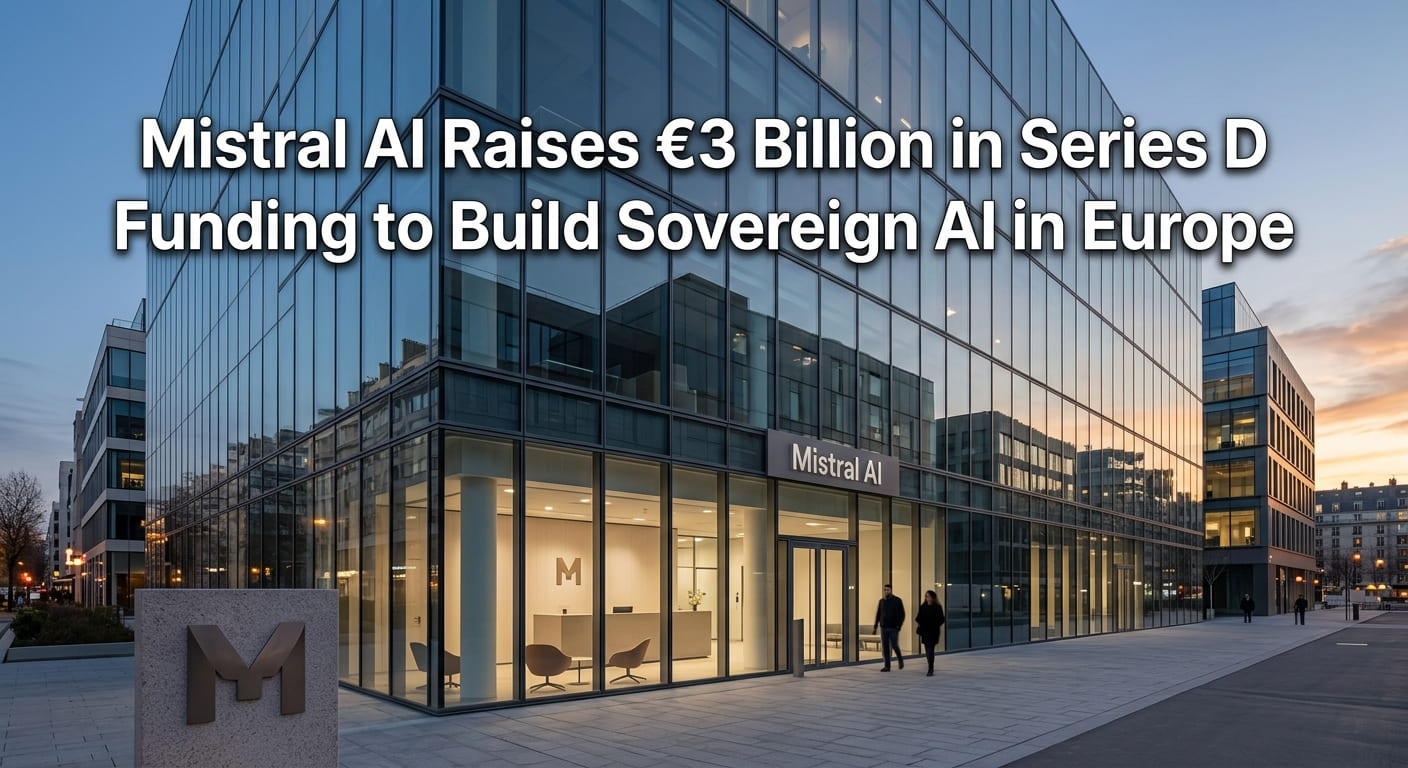
A French AI lab just pulled in one of the biggest tech investments Europe has ever seen. Mistral AI announced a €3 billion funding round, worth about $3.58 billion. That deal pushed its post-money valuation past €21 billion, or roughly $24.39 billion.
This is a Series D funding round. That simply means it is the fourth major round of investment a company raises after proving it can grow. Mistral calls it the largest equity fundraising round ever completed by a European technology company.
Big number. But the money is only half the story. The other half is what Mistral AI plans to do with it and why so many powerful backers wanted it in.
Let’s break it down in plain terms.
Who Put Up the Money
The Series D funding was led by Samsung Electronics. That is the same Samsung you know for phones and TVs, now placing a large bet on a European AI company.
Two co-leads joined Samsung. The first is the EQT-managed Scaleup Europe Fund. The second is PSG Equity, an existing investor that was already on board and chose to add more.
Here is a simple way to think about it. When existing backers double down, it usually means they like what they see. New backers signal fresh confidence. This round had both.
And the list runs long. American investors joined too. Existing backers like a16z, Nvidia, and Salesforce Ventures put in more money. New American names appeared as well: Advent and BlackRock. The Grand Duchy of Luxembourg also came in as a new backer, alongside many European investors adding to their stakes.
So the cap table stays international by design. That word “cap table” just means the list of everyone who owns a piece of the company.
The takeaway for you: this was not a single lucky check. It was broad support from Asia, Europe, and the United States at once.
What Mistral AI Actually Is
Mistral AI is an AI lab based in France. An AI lab is a company that builds and trains artificial intelligence models, the systems behind tools like chatbots and writing assistants.
But Mistral is quick to say what it is not. It is not trying to build a European ChatGPT. Its models have not gone mainstream the way OpenAI’s or Anthropic’s have. And that is fine, because Mistral is playing a different game.
Instead of selling AI models to everyone, Mistral focuses on governments and corporations. It helps large organizations use AI while keeping control over their own data. That is the core of its pitch.
Think of it like the difference between a public restaurant and a private chef. OpenAI and Anthropic serve the crowd. Mistral wants to cook inside your kitchen, on your terms.
The company already operates in 20 countries. So while it is French, its reach is far wider than France alone.
The takeaway for you: Mistral is an AI services provider first, not a consumer app maker.
The Big Idea: Sovereign AI
The phrase you need to understand here is sovereign AI. It sounds technical, but the idea is simple.
Sovereign AI means a country or company can run artificial intelligence on its own terms, without depending on foreign providers. It covers where your data sits, who processes it, and which rules apply.
Why does this matter now? Because many European organizations worry about relying too heavily on the United States for tech. AI regulation is tightening on both sides of the Atlantic. Politics around AI products in the U.S. keeps shifting. That makes some buyers nervous about handing everything to American firms.
Mistral is selling the answer to that worry. Its whole strategy leans into sovereign AI infrastructure, which is the physical and digital backbone that keeps AI running locally.
You do not need to understand the deep engineering behind AI infrastructure to grasp why this appeals to a government, in the same way you do not need to understand electrical wiring to want a reliable power supply in your own building. Buyers want control. Mistral is offering it.
The takeaway for you: Mistral’s biggest selling point is not smarter AI. It is AI that customers can control.
Where the €3 Billion Goes
Raising money is one thing. Spending it well is another. Mistral has been clear about its plans.
Here is where the €3 billion funding is headed:
- Scale up compute capacity. Compute capacity is the raw computing power needed to train and run AI. More of it means bigger, faster models.
- Build AI infrastructure. This is the data centers and hardware that make everything else possible.
- Speed up commercial growth. That means winning more customers and earning more revenue.
- Fund international expansion. The company wants to grow its footprint beyond its current 20 countries.
There is also a headline goal tied to hardware. Mistral wants to build 1 GW of compute capacity in Europe by 2030. A gigawatt is a measure of power, and one gigawatt is a serious amount. It signals Mistral intends to own its capacity, not just rent it from others.
The takeaway for you: this money is meant to buy independence, not just growth.
How Mistral Gives Customers Control
The strategy is not only talk. Mistral has shipped real tools to back it up.
In August, the company launched AI query region control. In plain terms, this lets customers choose which regions their AI requests get processed in. If a European bank wants its data handled inside Europe, it can require exactly that.
Mistral also started hosting open-weight AI models. An open-weight model is one whose internal settings are shared openly, so others can run and adjust it. Mistral even hosts some Chinese AI models on its platform.
That last part raised eyebrows. Some critics read it as a sign Mistral was turning into a plain inference provider, a company that just runs other people’s models rather than building its own. Mistral pushed back on that reading.
The company described its frontier research as the foundation underpinning its infrastructure, products, and sovereignty. Frontier research means the cutting work of building new, advanced AI models from scratch. So Mistral is saying: yes, we host others’ models, but we still build our own.
The takeaway for you: Mistral wants to be both a model builder and a flexible platform, not one or the other.
The Politics Behind the Deal
This round carried weight beyond business. It caught the attention of national leaders.
Samsung’s entry onto Mistral’s cap table reportedly had the blessing of French authorities. And French president Emmanuel Macron posted about it directly. He said the round reflected France and South Korea’s shared goal of building a “third way in AI.”
That phrase is worth unpacking. Today, AI power sits largely in two places: the United States and China. A “third way” means Europe and its partners carving out their own path, not fully dependent on either side.
The fact that a funding round drew a statement from a head of state tells you something. Mistral is treated as a national champion, a company France wants to see win on the world stage.
And being non-American has helped. Amid rising demand for sovereign AI infrastructure, not being a U.S. company has reportedly boosted Mistral’s revenue. Some buyers specifically want an alternative.
The takeaway for you: Mistral’s location and independence are part of the product, not just background details.
The Honest Limits
Now the caveats. Because this is not a guaranteed win, and it helps to see the risks clearly.
First, the money problem. The capital needed to compete with top U.S. labs is not available in France alone. That is exactly why Mistral had to look abroad, bringing in Samsung from South Korea and American giants like BlackRock and Nvidia.
Second, the independence tension. Mistral sells itself on reducing U.S. dependency. Yet it still works closely with Microsoft through a strategic partnership the two expanded in July. It also took American investment. So “independent” here means balanced across many countries, not free of the U.S.
Third, the market position. Mistral’s models have not reached mainstream use. It is betting on governments and corporations rather than the general public. That is a narrower path than the one OpenAI and Anthropic walk.
This approach is not unique either. Germany’s Aleph Alpha merged with Canada’s Cohere in a similar hunt for scale across borders. And with Dutch chipmaker ASML already a major partner and investor, plus Samsung now on board, Mistral is stitching together a genuinely international “third way.”
The takeaway for you: the strategy is promising, but it depends on partners Mistral does not fully control.
Why This Matters
Step back and the picture gets clear. A European AI company just raised €3 billion at a post-money valuation above €21 billion. That alone marks a shift in where serious AI money is flowing.
But the deeper story is about choice. For years, large organizations felt they had two options for advanced AI, both concentrated in a handful of American firms. Mistral is building a real alternative, one focused on control, regional data handling, and sovereign AI infrastructure.
Whether that bet pays off depends on execution. Building 1 GW of compute capacity in Europe by 2030 is a huge undertaking. Winning governments and corporations at scale takes time. And staying independent while relying on Samsung, ASML, and Microsoft is a delicate balance.
Still, the signal is strong. When Samsung Electronics leads a round this size, when the EQT-managed Scaleup Europe Fund and PSG Equity co-lead it, and when a president weighs in, you know the stakes reach past one company.
Conclusion
Mistral AI’s €3 billion funding round is more than a large check. It is a clear statement about how Europe wants to compete in AI. This Series D funding, led by Samsung Electronics with the EQT-managed Scaleup Europe Fund and PSG Equity as co-leads, pushed Mistral to a €21 billion valuation and cemented its role as a leading European technology company.
The plan behind the money is focused. Mistral AI wants to grow compute capacity, expand its AI infrastructure, and push international expansion beyond its current 20 countries. It is betting on sovereign AI, on giving governments and corporations control over their data through tools like AI query region control, and on serving as a flexible AI services provider that hosts open-weight AI models while continuing its own frontier research.
The risks are real and worth naming. Mistral still leans on partners like Microsoft, ASML, and now Samsung. Its models have not gone mainstream. And building 1 GW of compute capacity in Europe by 2030 is a promise it now has to keep.
But the direction is set. With backing from Nvidia, a16z, Salesforce Ventures, Advent, BlackRock, and Luxembourg, and with Macron framing it as a “third way in AI” alongside South Korea, this European AI company has the money and the momentum to try.
Here is your one action: Watch what Mistral builds next. The funding is confirmed. Now the results have to follow.





Be First to Comment