
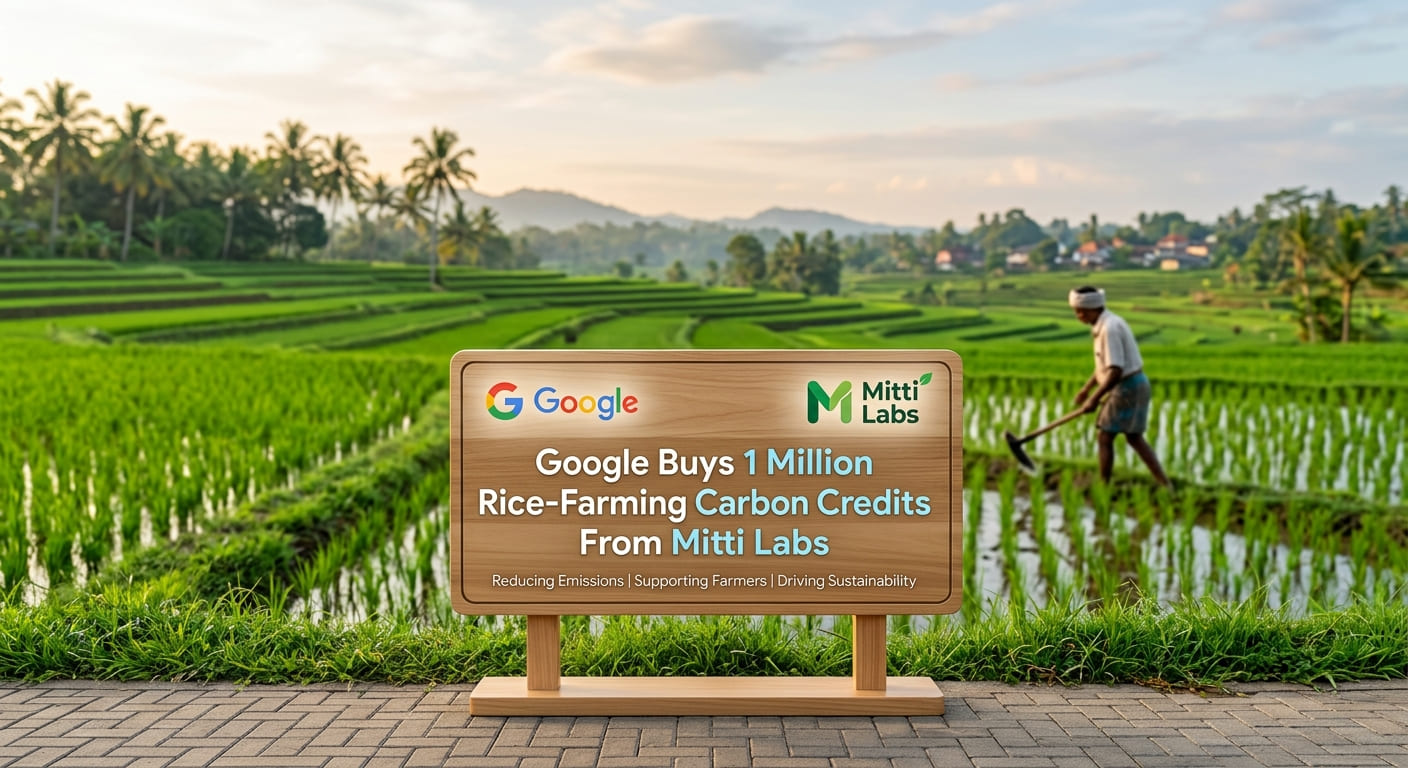
Google is now paying to change how rice gets grown in India.
The company has agreed to buy 1 million carbon credits from Mitti Labs, an Indian climate-tech startup, through 2030. Both companies say it is the largest publicly announced deal ever for credits tied to cutting methane emissions in rice farming. Financial terms were not shared.
Here is what the deal actually does, how it works on the ground, and why a search giant cares about flooded fields. We will define the tricky terms as we go, so you do not need a background in climate science to follow along.
What This Deal Covers
Start with the plain version. Google is buying carbon credits, and Mitti Labs is generating them.
A carbon credit is a unit that represents one ton of greenhouse gas kept out of the air. Companies buy these credits to offset emissions they cannot easily cut on their own. In this case, the credits come from rice farms that release less methane.
The agreement runs four years and covers three Indian states: Karnataka, Andhra Pradesh, and Telangana. At its peak, the project will reach about 100,000 hectares of rice fields. That is a wide stretch of farmland producing measurable climate benefits.
You do not need to understand carbon markets to grasp the trade here, in the same way you do not need to know how a recycling plant works to sort your bins. Google pays. Farmers change their methods. Less methane goes up.
Keep this straight: Google is not planting anything. It is funding a farming change and buying the emissions savings that result.
Why Rice Farming Releases So Much Methane
Here is the part most people miss. Rice fields are a surprising source of a powerful greenhouse gas.
When rice paddies stay flooded, the water blocks oxygen from reaching the soil. In that airless mud, bacteria break down organic matter and produce methane. Methane is a greenhouse gas far stronger than carbon dioxide over the short term.
So the longer a field sits underwater, the more methane it releases. That is the problem Mitti Labs targets.
The fix is straightforward in concept. Farmers reduce how long their fields stay flooded. Less standing water means less methane and less oxygen-starved mud.
Mitti Labs says the technique can cut methane emissions by about 50%. It also reduces irrigation water use by roughly 40%. And it does this without lowering crop yields, according to the startup.
The takeaway for you: the same change that cuts methane also saves water. That double benefit is a big reason this project stands out.
The Technology That Makes It Trustworthy
A carbon credit is only worth something if the savings are real. So how does anyone prove a field released less methane?
This is where Mitti Labs’ technology comes in. Founded in 2023 and based in New York and Bengaluru, the startup built what it calls a GeoAI platform. In plain terms, it uses AI and satellite data to watch farms from above.
The system combines satellite radar imagery with measurements taken directly in the fields. Together, these track crop growth, soil moisture, and flooding across many small farms at once.
The satellites use something called synthetic aperture radar. That is a type of radar imaging that works day or night and can see through clouds. Its resolution ranges from 50 centimeters to 10 meters, meaning it can spot detail down to under a meter. Mitti Labs also feeds its own field data into its AI models to sharpen the results.
Here is why that matters for the deal. Google did not just take the startup’s word. Its review included scrutiny of the monitoring technology and actual visits to farms before signing.
Do this if you ever assess a carbon claim: ask how the savings are measured, not just how big they are. Measurement is what separates a real credit from a guess.
The Checks Behind the Credits
Trust does not stop at the technology. The credits also pass through outside review.
The credits sold to Google can be issued under either Gold Standard or Isometric. Both are carbon-credit certification bodies, meaning independent organizations that set rules for what counts as a legitimate credit.
On top of that, the projects go through third-party verification before any credits are issued. That means an outside party checks the work, not just the company selling it.
This layered checking is not a small detail. The carbon credit market has faced real criticism over credits that did not deliver promised savings. Independent verification is how a project answers that doubt.
Keep this straight: a credit backed by third-party verification carries more weight than one that is self-reported. Always look for who checked the numbers.
Why Google Needs This
Now the question behind the headline. Why is a technology company buying rice-farm credits at all?
The short answer is a promise Google made. The company has pledged to reach net-zero emissions by 2030. Net-zero means removing or offsetting as much greenhouse gas as it puts out.
That promise is getting harder to keep. Google is investing heavily in AI infrastructure, and running AI takes enormous amounts of energy. Its greenhouse gas emissions in 2025 grew 18% from the year before, reaching about 14.5 million metric tons of carbon dioxide equivalent, per its environmental report released in June.
So emissions are rising while the deadline stays fixed. That gap is why Google is hunting for credible ways to cut and offset carbon.
Mitti Labs said talks began about a year ago, as Google explored adding methane-reduction projects to its carbon-credit portfolio. According to co-founder Xavier Laguarta, Google was drawn in part to the water savings and the startup’s ability to work at scale.
The takeaway for you: when a company’s emissions climb, it leans harder on offset deals like this one. Watch both numbers together, not just the pledge.
What It Means for Mitti Labs
For the startup, landing Google is more than a sale. It is a stamp of approval.
“Having Google, one of the most sophisticated buyers in the market with rigorous due diligence processes, is obviously a good signal for us,” Laguarta said. He added that the deal would let Mitti Labs scale up significantly.
The company already has a track record. Its projects have saved more than 500 billion liters of water over the past two years. It currently works with more than 100,000 farmers and wants to reach millions by 2030.
Google is not its only customer. Mitti Labs also works with the carbon marketplace Cool Effect, rice producer Ebro Foods, and agricultural company Syngenta. But Laguarta called the Google agreement the startup’s largest offtake deal to date. An offtake deal is simply a commitment to buy a set amount of a product over time.
There is one number Laguarta would not share. He declined to say how much participating farmers in the Google project would earn, though he noted that a majority of project revenue goes to farming communities.
One thing to remember: a big-name buyer can validate a startup, but undisclosed farmer pay is worth watching. Follow up on where the money actually lands.
The Bigger Picture Beyond India
This project stays inside India for now. But Mitti Labs is looking well past it.
The startup plans to launch operations in the Philippines later this year. It aims to expand into Indonesia and other parts of Southeast Asia in 2027. The reason is scale. About 150 million farmers grow rice across India, Southeast Asia, and China, according to Laguarta.
That is a huge pool of potential methane savings. As more companies chase agricultural projects to cut methane, Laguarta sees room for the market to grow.
Google, meanwhile, has been busy in India on climate before this. In January 2025, it partnered with Gurugram-based Varaha to buy 100,000 tons of carbon credits. That was Google’s first large-scale carbon removal purchase in the country and the largest deal involving biochar, a charcoal-like material made from biomass that traps carbon.
The company is also funding clean energy there. It signed an agreement tied to a 150-megawatt solar project in Rajasthan. That brought its contracted solar capacity with the firm ReNew in the state to 300 megawatts, part of an effort to address its supply-chain emissions.
Do this to track the trend: watch whether other tech giants follow Google into rice-farming credits. One large deal often signals a market others will test.
Why This Deal Matters
Step back, and the shape of the story is clear. A tech company with rising emissions is paying farmers to grow rice in a cleaner way.
The appeal is real on several fronts. The method cuts methane by about half. It saves water by around 40%. It keeps yields steady. And it routes most of the revenue to farming communities. Those are concrete outcomes, not vague promises.
But keep the caveats in view. Financial terms were not disclosed. Farmer pay was not revealed. And carbon credits, as a category, have earned scrutiny for a reason. The third-party verification and certification here are the answer to that doubt, but they are worth checking, not assuming.
The honest read is this. This is a large, well-vetted bet on a practical climate fix, tied to a company that badly needs offsets as its AI energy use climbs. Whether it scales across Southeast Asia is the real test ahead.
Pick one thing to watch: follow whether Mitti Labs hits its move into the Philippines this year. That expansion will show if this model works beyond India.
Frequently Asked Questions
1. What did Google agree to buy from Mitti Labs?
Google agreed to buy 1 million carbon credits from Mitti Labs through 2030. The companies say it is the largest publicly announced deal for credits from cutting methane emissions in rice farming. Financial terms were not disclosed.
2. How does the project actually cut methane?
Farmers reduce how long their rice fields stay flooded. Less standing water means less methane released from the soil. Mitti Labs says the method cuts methane by about 50% and irrigation water use by about 40%, without lowering crop yields.
3. How are the carbon savings verified?
Mitti Labs uses a GeoAI platform that pairs satellite radar imagery with field measurements to track flooding and soil moisture. The credits can be issued under Gold Standard or Isometric, and projects undergo independent third-party verification before credits are issued.
4. Why is Google buying rice-farming carbon credits?
Google has pledged to reach net-zero emissions by 2030, but its emissions grew 18% in 2025 to about 14.5 million metric tons of CO2 equivalent, driven partly by AI infrastructure. Deals like this help offset emissions it cannot easily cut.
5. Where does the project operate, and will it expand?
The Google project covers rice farms in Karnataka, Andhra Pradesh, and Telangana, reaching about 100,000 hectares at peak. Mitti Labs plans to launch in the Philippines later this year and expand into Indonesia and other Southeast Asian markets in 2027.





Be First to Comment