
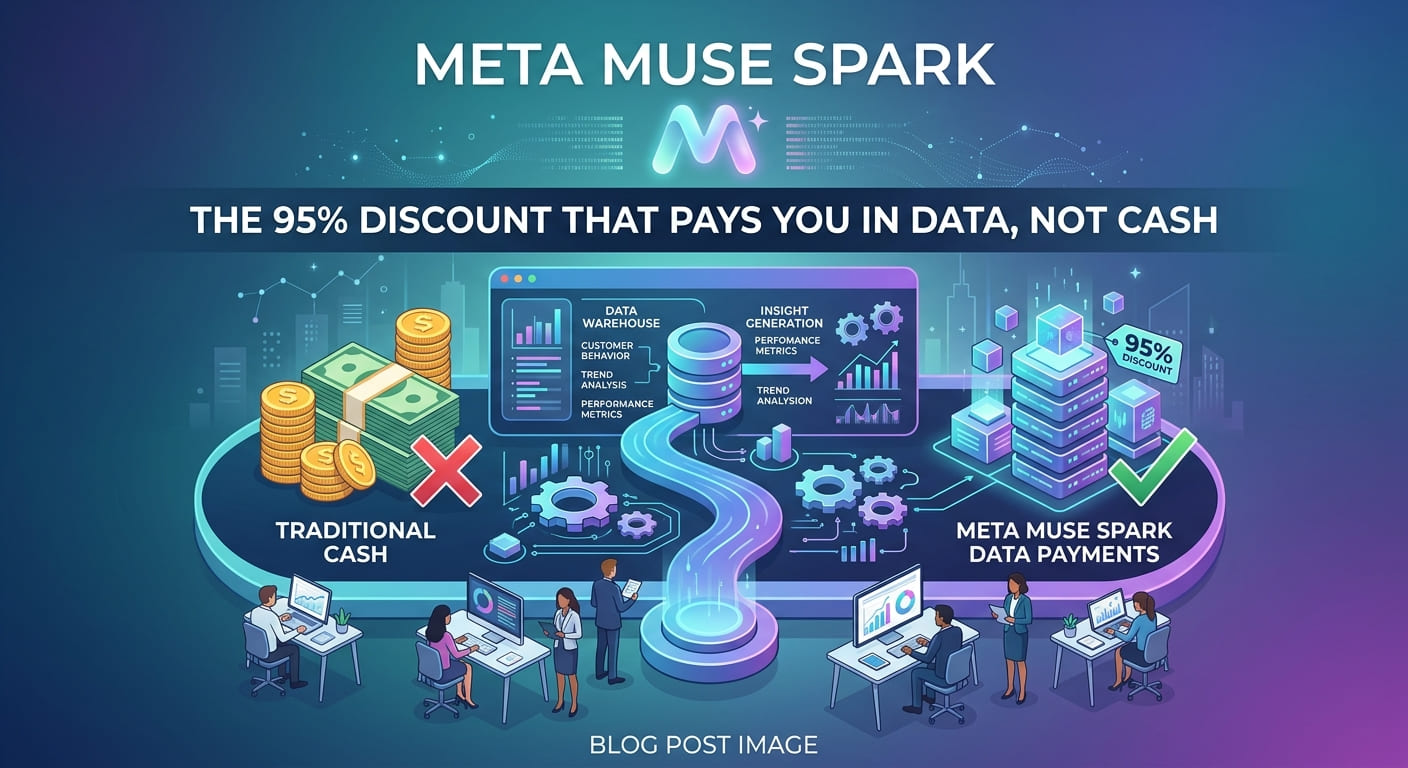
Meta has a new deal for anyone building with its AI. Use its latest model at a steep discount, but let the company keep your prompts and results to train future versions.
That is the trade at the heart of Meta Muse Spark. It is a model built for coding and other agentic tools, and Meta is willing to cut the price by about 95% for users who agree to share.
Here is how the offer works, what you actually give up, and why this small pricing tweak says something bigger about the AI industry.
What Meta Muse Spark Actually Is
Start with the basics. Muse Spark is Meta’s new AI model designed to run coding assistants and other agents.
An agent is software that takes actions on its own to finish a task, rather than just answering one question. Muse Spark is the engine meant to power those tools.
You do not need to understand how the model works under the hood to grasp the deal—in the same way you do not need to know how a phone plan is priced to notice a discount. What matters is the offer attached to it.
Meta is charging two prices for the same model. One is the standard rate. The other is the contributor rate, and it is far cheaper.
The catch sits in that word: contributor. You pay less because you contribute your data back.
The Numbers Behind the 95% AI Discount
Let’s put real figures on this. AI models charge by the token, which is roughly a chunk of text. You pay for what goes in and what comes out.
Here is the standard token pricing versus the contributor tier:
- Input tokens cost $1.25 per million under the standard agreement.
- Input tokens cost just $0.10 per million under the contributor pricing model.
- Output tokens cost $4.25 per million under the standard agreement.
- Output tokens cost just $0.20 per million under the contributor model.
Do the math, and the average saving lands around 95%. That is the 95% AI discount in plain terms.
For a small team running experiments, that gap is huge. A bill of $100 could shrink to about $5.
But cheap does not mean free. You are paying with something other than money.
What You Give Up: Prompt and Output Sharing
Here is the honest part. Under the contributor model, Meta keeps your prompts and the model’s responses.
That data becomes AI training data. Meta uses your prompt and output sharing to build and improve future models.
Most AI tools let you opt out of this kind of model provider data sharing. Meta has flipped the logic. Instead of asking you to opt out, it pays you to opt in.
Meta’s own pricing guide is blunt about the target user. It says the contributor tier “lowers the barrier to entry for prototyping, testing integrations, and scaling experiments where training on your data is acceptable.”
Read that carefully. The phrase “where training on your data is acceptable” is doing the heavy lifting.
This is not a guarantee that your data stays private. It is the opposite—a clear notice that your data feeds the machine. That is the deal you accept for the lower rate.
Before you sign up, ask one question: is anything in my prompts sensitive? If the answer is yes, the discount is not worth it.
Why Meta Needs Your Data So Badly
The discount is not charity. Meta has struggled to get good training data, and this is a workaround.
Earlier this year, the company launched an internal program to track how its own employees used their computers. The idea was to gather real workflow data. It drew wide criticism inside the company and was paused in June.
So Meta needs another source. Paying outside users for their prompts and outputs is that source.
There is a real reason this data matters so much for agentic tools. Real usage teaches a model what actually works.
Mario Zechner, the developer behind the open-source harness Pi, explained the pattern to TechCrunch. He pointed to the jump in coding agent capabilities between April 2025 and October 2025.
The cause, he said, was data. Claude Code stored coding sessions by default and used them for reinforcement learning training—a method where a model learns from feedback on its own attempts.
In plain terms: the more real sessions a model sees, the faster it improves. Meta wants that same fuel, and the contributor pricing model is how it plans to buy it.
The Problem with Selling Data You Don’t Fully Understand
There is a wrinkle here that Meta cannot easily solve. Coding leaves clear digital traces. Many other professional workflows do not.
A software session can be logged, replayed, and scored. A lawyer’s reasoning or a consultant’s judgment is much harder to capture. As model builders push agentic tools beyond software engineering, this gap slows them down.
That is why real usage data is so valuable and so hard to get. The contributor tier is Meta’s attempt to buy the traces it cannot generate on its own.
But not everyone wants to sell. Arvind Narayanan, a computer science professor at Princeton, points out that big companies often refuse.
He noted that large firms stick with token-billed enterprise plans even when consumer plans like Claude Max and ChatGPT Pro run 10 to 20 times cheaper. The main difference between those plans is data retention and enterprise IT governance.
Put simply: big companies pay more to keep control of their data. They value privacy over the discount.
Narayanan suggests Meta’s cash offer could change how firms think. Faced with real money, a company might sort its data into two piles—the proprietary company data it must protect and the low-risk data it can share for a discount.
Here is the takeaway for you. Do the same sorting before you opt in. Decide what is safe to share and what must stay locked, one project at a time.
How This Fits the Wider Price War
Meta is not moving in a vacuum. The Frontier Labs competition on price is heating up, and this is one more shot.
The pattern is clear across the industry:
- Anthropic released its Fable and Mythos models with lower cached tokens pricing, which reduces the cost of reusing repeated context.
- OpenAI rolled out major price cuts at the end of July.
- Meta answered with the contributor pricing model and its steep discount.
Each lab is racing to be the cheapest way to run AI at scale. But Meta’s approach is different in kind, not just degree.
OpenAI and Anthropic cut the sticker price. Meta cut the price in exchange for your data. That is a new lever in the AI model pricing fight.
Watch which approach wins. If enough users take the data-for-discount trade, expect rivals to copy it.
Is the Contributor Tier Worth It for You?
Here is the plain verdict. The answer depends entirely on what you are building.
For low-stakes work, the deal is strong. Prototypes, tests, and throwaway experiments carry little risk if the data leaks into training.
For sensitive work, walk away. Client data, private code, and anything covered by a contract do not belong in a model provider’s training set.
Use this simple check before you choose a tier:
- List what your prompts will contain.
- Mark anything private, contractual, or proprietary.
- If that list is empty, the contributor tier and its 95% AI discount make sense.
- If it is not empty, pay the standard rate and keep control.
This is not a hard decision once you name the data out loud. The mistake is opting in without looking first.
Pick one project you are running now. Sort its data using the four steps above. Decide before you save a single dollar.
Why This Matters
Meta Muse Spark turns a quiet industry habit into an open price tag. Your data has always had value to AI companies. Now that value is printed on the invoice.
That clarity is useful. For years, model provider data sharing happened in the background, buried in settings and terms. Meta has dragged it into the open and named a number.
The lesson is not that sharing is bad or good. It is that you now get to choose with real information in front of you. Cheap AI is available, as long as you know what you are paying with.
Look at your next AI bill and ask what the discount would really cost. That single question is the whole story here.
Frequently Asked Questions
1. What is Meta Muse Spark?
Muse Spark is Meta’s new AI model built to run coding assistants and other agentic tools.
2. How much can I save with the contributor pricing model?
About 95% on average. Input tokens drop from $1.25 to $0.10 per million, and output tokens drop from $4.25 to $0.20 per million. The catch is that Meta keeps your prompts and outputs to use as AI training data.
3. What exactly does Meta take in exchange for the discount?
This prompt and output sharing feeds Meta’s future models. Most tools let you opt out of this kind of model provider data sharing, but Meta pays you to opt in instead. It is not private; the discount is the trade.
4. Why does Meta need this data at all?
Real usage teaches models what works. Meta tried gathering workflow data by tracking its own employees earlier this year, but the program was paused in June after internal criticism. Buying outside users’ data is the workaround.
5. Should I use the contributor tier?
Only for low-stakes work. For prototypes and experiments with no sensitive data, the discount is worth it. For client data, private code, or proprietary company data, pay the standard rate and keep control.


Be First to Comment