
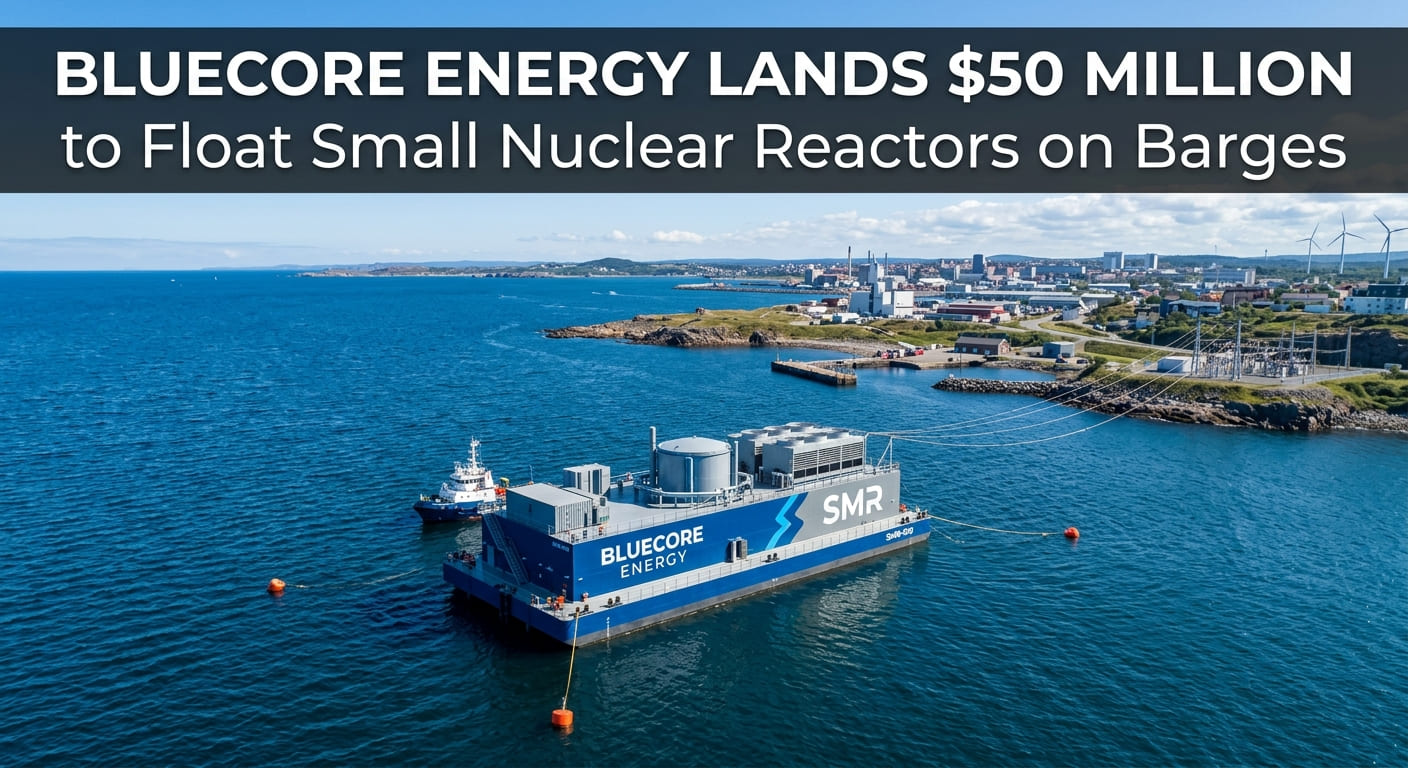
Picture a power plant that does not sit still. It floats. It can be pulled to a port, a struggling town, or a hungry data center, then deliver power without a decade of construction first. That is the bet behind Bluecore Energy, and investors just backed it with real money.
The company announced an oversubscribed $50 million seed round on Tuesday. What makes the news land harder is the speed. Bluecore Energy only closed a $10 million pre-seed a few months earlier, right as it stepped out of stealth. Two raises in a single year is a fast clip for any nuclear startup.
Here is what the company builds, who is funding it, and why it matters to you. We will keep the nuclear terms simple and define them as we go.
What Bluecore Energy Actually Builds
Bluecore Energy builds small nuclear reactors and mounts them on floating barges. Instead of a fixed plant bolted to one patch of land, the reactor rides on a vessel that moves.
Small nuclear reactors go by the shorthand SMRs. An SMR is exactly what it sounds like: a nuclear reactor built at a smaller scale than a giant traditional plant. Smaller size means it can reach places a huge reactor never could.
The barge is the twist that changes everything. A normal power plant takes years to build and never moves once finished. A floating nuclear power plant can be towed to wherever demand sits. That flips the timeline for anyone who needs clean energy but cannot wait ten years for a new site.
Think of the difference between a house and a mobile home. One is fixed forever. The other travels with you. Bluecore Energy is wagering that the movable version fits a surprising number of real needs.
The company was founded earlier this year by Kofi Asante. His pitch is plain: clean power should reach the people who need it most, and moving the source beats building fresh infrastructure around a fixed one.
Try this now: picture a port that needs clean energy next year, not in ten. That gap is exactly what Bluecore Energy is aiming at.
Why “Floating” Is Not as Wild as It Sounds
Putting a reactor on water sounds risky at first. Asante’s answer is that it has been done for decades already.
“The Navy is doing this as we speak, for the last 70 years, and has never had an accident,” Asante told TechCrunch about portable nuclear technology. His team, he says, simply shrank the concept so units can be moved in days rather than years.
You do not need to understand reactor physics to follow the logic here, in the same way you do not need to understand jet engines to trust that planes fly safely every day. The core claim is simple. Portable nuclear power has a long track record, and Bluecore Energy is adapting a proven approach for civilian use.
That framing matters for a nuclear startup. Public trust is often the hardest thing to earn in this field. Pointing to 70 years of naval use is a way of saying the idea is old, even if the packaging is new.
Keep this straight: the reactors are small, the barges move, and the underlying method is not experimental. That is the foundation of the whole floating nuclear reactor pitch.
Inside the $50 Million Seed Round
An oversubscribed seed round means more investors wanted in than there was room for. That is a good sign. It tells you demand ran ahead of supply.
Asante says he was not even planning to raise money this year. The calls kept coming after the $10 million pre-seed, and he had to keep clearing space on the cap table. A cap table is just the list of everyone who owns a slice of the company.
Here is who backed the $50 million seed round:
- Silverton Partners led the new round.
- Several pre-seed investors doubled down, including Slauson & Co., Harlem Capital, and Ripple co-founder Chris Larsen.
- Fresh money arrived from Collab Capital and Kevin Hart’s HartBeat Ventures.
- Angel investors came from Tesla, Uber, Amazon, and Google.
The round took eight weeks to close. For context, pulling in $50 million in two months is quick, especially in a field as regulated and capital-heavy as nuclear.
“I wasn’t anticipating us raising that level of capital in that period of time,” Asante said, adding that he felt fortunate to have so many excited investors and partners.
The takeaway for you: when existing backers add more and new names pile in, it usually signals confidence in the plan, not just the pitch.
Home Base at the Port of Long Beach
When Bluecore Energy left stealth in July, it did something no nuclear company had done before. It set up headquarters at a major port: the Port of Long Beach.
That location is not for show. A floating nuclear power plant needs water, docks, and a direct link to the infrastructure it powers. Basing the nuclear startup at a working port puts the technology right next to its first natural customer.
Since then, the company has launched two nuclear barges. It also lined up partnerships with three key bodies:
- The Department of Transportation Maritime Division.
- The U.S. Nuclear Regulatory Commission, known as the NRC.
- The U.S. Coast Guard.
These are not casual relationships. The NRC and the Coast Guard are now running a product design review on Bluecore Energy’s reactors. If that review clears, it leads to certification of the floating nuclear power plant.
Asante says the company spoke with both agencies from its earliest days, but the formal engagement officially started in August.
Why this matters: certification is the gate every nuclear startup must pass through. No approval, no deployment. Watch the NRC and Coast Guard review as the real milestone, not the funding headline.
Where the $50 Million Goes Next
Raising money is one thing. Spending it well is another. Bluecore Energy has a clear plan for the cash.
The fresh capital is headed toward four areas:
- Continue product development on the reactors and barges.
- Fund the regulatory work moving the NRC and Coast Guard review forward.
- Cover nuclear fuel purchases for the first units.
- Hire to grow the team.
Asante already sees the biggest hurdle coming. It is not the science. It is the supply chain, meaning the network of parts and hardware needed to build portable energy infrastructure fast enough to meet demand.
His team is borrowing playbooks from hard-tech to solve it. “Our team comes from SpaceX, Rivian, and Toyota, so we are applying similar strategies to be able to secure critical parts,” he said. The company already has barges and a reactor and is about to order nuclear fuel for delivery to a partner at a national nuclear lab.
One thing to remember: in hardware, the plan often lives or dies on parts, not ideas. Bluecore Energy is treating the supply chain as its top risk, which is a healthy sign.
Who Actually Wants a Floating Reactor
The demand side is where this gets interesting. Asante says inbound interest is already coming from three groups: multiple ports, AI data centers, and communities that need clean energy and clean water.
AI data centers are the customer to watch. These facilities run enormous computing loads, and that computing eats electricity at a scale that strains local grids. A movable floating nuclear power plant offers a way to deliver steady clean energy right where a data center sits.
Here is the plain version of the appeal:
- Ports need reliable clean energy near the water, and the barge is already there.
- AI data centers need large, constant power without waiting years for a new plant.
- Remote and underserved communities need both clean energy and clean water but struggle to build fixed infrastructure.
You do not need to run a data center to see why this lands, in the same way you do not need to own a factory to understand why a backup generator is useful. When the grid cannot keep up, a power source you can move to the problem carries obvious value.
The honest caveat: interest is not the same as signed contracts. Inbound demand is promising, but certification comes first. Do not read early enthusiasm as guaranteed sales.
The Bigger Mission Behind the Barges
For Asante, the technology serves a simple goal. He describes the mission as democratizing access to clean energy.
“My philosophy is that access to clean energy and also clean water should be a human right,” he said.
That belief explains the design choices. A fixed plant serves whoever happens to live nearby. A set of floating nuclear reactors can serve a port this year and a struggling community the next. Mobility is the point, not a side feature.
Whether Bluecore Energy delivers depends on the hard parts still ahead. It has to pass the NRC and Coast Guard product design review, secure nuclear fuel, and build a supply chain that keeps pace with demand. None of that is settled. A mission statement does not clear a regulator.
But the direction is set, and the money is now in the bank to try.
Pick one thing to track: the certification of the floating nuclear power plant. That single milestone tells you whether the idea is becoming real.
Conclusion
Bluecore Energy has the money, the backers, and the barges to chase a genuinely new idea: put small nuclear reactors on floating barges and move clean energy to wherever it is needed. The $50 million seed round led by Silverton Partners, stacked on the earlier $10 million pre-seed, gives founder Kofi Asante real fuel to push through the NRC and U.S. Coast Guard product design review, order nuclear fuel from a national nuclear lab, and answer inbound interest from ports and AI data centers. This is not a guarantee of success, since certification and the supply chain still stand in the way, but it is one of the most closely watched bets in clean energy right now.






Be First to Comment