
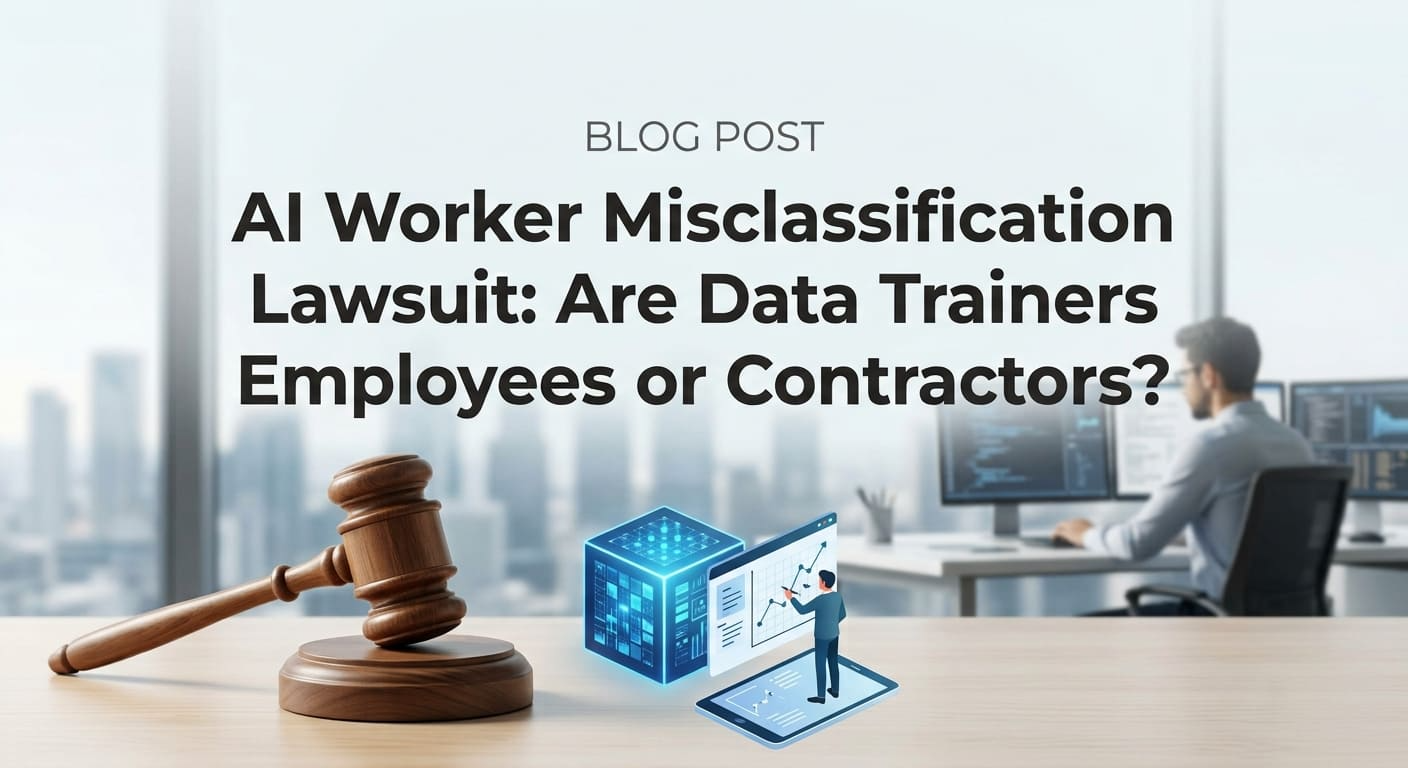
AI is often sold as a machine that runs itself. It does not.
A new lawsuit has put a spotlight on the humans who make these systems work. An artificial intelligence company stands accused of labeling its data trainers as independent contractors when, the complaint says, they should have been treated as employees. That single distinction carries real money and real protections, which is exactly why this AI labor lawsuit matters.
Here is what the case involves, what data trainers actually do, and why the fight over the word “employee” reaches far beyond one company. We will define the legal terms in plain language as we go, so you do not need a background in employment law to follow along.
What We Know, and What We Do Not
Start with the facts we have. The complaint claims the company controlled and structured the trainers’ work closely enough that they qualified as employees, not contractors.
That is the core of the dispute. The workers say the arrangement looked like a job in everything but name.
Now the honest part. The available report does not name the company. It does not name the workers bringing the case, the court handling it, or the exact remedies they are asking for.
So treat this as one side of a story that is still forming. A lawsuit is a claim, not a verdict. The company has not answered yet, and it will get its chance.
Keep this straight: a filing tells you what one group alleges. It does not tell you who is right. Wait for both sides before drawing a conclusion.
What a Data Trainer Actually Does
A data trainer is a person who helps prepare and improve the information an AI system learns from. That is the plain version.
You have probably pictured AI as software that teaches itself. In reality, people do a lot of the teaching. These workers, sometimes called trainers and annotators, sit behind the scenes doing hands-on tasks that shape how a model behaves.
Here is the kind of work involved:
- Rank model responses from best to worst so the system learns what a good answer looks like.
- Label text or images so the model can tell one thing from another.
- Review outputs to catch mistakes before they reach users.
- Write examples the model can learn from.
- Evaluate safety issues, flagging harmful or risky answers.
That work feeds directly into machine-learning systems. Without it, the polished chatbot you use would be far rougher and far less safe.
You do not need to understand how a model is trained to grasp the point here, in the same way you do not need to know how a kitchen runs to know someone cooked your meal. The output feels automatic. The labor is very human.
The takeaway for you: the next time an AI answer feels smooth, remember a person likely helped teach it. That person’s job status is what this case is about.
Employee vs Independent Contractor: Why the Label Matters
This case turns on one question: were these workers employees or independent contractors? The answer decides what the company owes them.
Here is the difference in plain terms. An employee comes with legal obligations attached. A contractor comes with far fewer.
When a worker is an employee, the law can require the business to provide things like:
- Minimum wages for the hours worked.
- Overtime pay when hours run long.
- Payroll-tax contributions paid by the employer.
- Unemployment insurance if the job ends.
- Workers’ compensation coverage for job-related injury.
- Reimbursement for certain business expenses.
Independent contractors usually get none of that guaranteed. They receive fewer statutory protections and carry more of their own taxes and costs.
So the label is not just paperwork. It is the difference between the company covering these protections or the worker absorbing the cost alone.
One thing to remember: the fight is not about the title on a contract. It is about the money and safety net that title turns on.
How Courts Actually Decide
Here is the part that surprises many people. A contract calling someone a contractor does not settle the matter.
Courts and regulators look past the label. They examine how the working relationship actually functioned, not just what the paperwork claimed.
The exact test varies by location. But most classification tests ask similar questions:
- How much control did the company have over the work?
- Could the worker set their own schedule?
- Could the worker negotiate their own rates?
- Was the work central to the company’s core business?
- Did the worker run a genuinely independent enterprise?
Think of it like judging whether someone is really self-employed. If a person picks their own hours, sets their own prices, and works for many clients, they look independent. If one company dictates their schedule, their methods, and their pay, that starts to look like a job.
The weight given to each factor depends on the legal standard that applies. No single answer decides everything on its own.
Try this now: picture any gig you have done. Ask yourself who set the hours and the rate. That instinct is close to how a court begins.
Why AI’s Staffing Setup Complicates Things
AI companies often build their workforce in a flexible, scattered way. That structure sits right at the center of this dispute.
Much of this work gets handed out through online platforms and project-based arrangements. A task appears, a worker claims it, and the job is done remotely. Large groups of people can work this way at once, spread across the world, without ever meeting a manager in person.
That setup does not automatically make someone a contractor. Flexibility alone does not settle the legal question.
Here is the tension. A contractor arrangement can be perfectly lawful when the worker keeps real independence over how the work gets done. But certain conditions push the relationship back toward employment:
- Detailed instructions on exactly how to complete each task.
- Performance monitoring that tracks the worker’s every move.
- Mandatory procedures the worker cannot change.
- Limits on the worker’s ability to make independent business decisions.
The more a company controls the details, the harder it becomes to call the worker independent. That is the exact ground where this case will be fought.
Keep this straight: working online and on your own schedule does not decide your status. Control does. Watch who holds it.
The Risk of a Much Bigger Case
This lawsuit could grow well past the people who filed it. That possibility is what makes it worth watching.
Here is why. If many trainers worked under the same policies, the workers bringing the case may try to represent a larger group. That is a collective or class claim, meaning one lawsuit stands in for many similar workers at once.
Whether that happens depends on a few things:
- What the complaint actually alleges.
- How similar the workers’ arrangements really were.
- Whether the court’s procedural rules allow it.
The pattern matters here. If the company used one common setup for thousands of trainers, a single ruling could touch all of them. If the arrangements varied widely, the case may stay narrow.
You do not need to track every legal filing to see the stakes, in the same way you do not need to follow a recall notice to know it affects more than one car. A shared policy can pull in a crowd.
The honest caveat: a class claim is a possibility, not a promise. It may never expand. Whether it does depends on facts we do not fully have yet.
Why This Case Speaks to a Bigger Shift
Step back, and this is about more than one company. It is about the human labor that quietly powers generative AI.
These products are marketed around automation. Yet their development leans on people who organize training material, judge outputs, and give feedback. That reality is getting more legal and public attention than ever.
Part of the challenge is how the work is packaged. Tasks get chopped into short assignments and routed through intermediary platforms. When responsibility is split across so many hands, it gets harder to pin down who is accountable for working conditions and legal compliance.
So this case is a test of a common model. It asks a simple question with wide reach: when a company depends on people to build its product, what does it owe them?
Do this before you close the page: the next time you read that AI “runs itself,” pause. Ask who trained it, and under what terms. That habit keeps the human cost in view.
What Happens Next
The company will get its turn. Right now, we only have the workers’ side.
The central question is clean, even if the answer is not. Did these trainers run their own independent businesses? Or did they work under conditions that required the company to treat them as employees?
A court will weigh the control, the schedules, the rates, and the independence, then decide. Until then, nothing is settled.
Pick one thing to follow: watch whether this case tries to expand into a class claim. That single move will tell you how far the ruling could reach.
Final Thought
This AI labor lawsuit puts a plain question to a fast-growing industry: are the people who train these systems employees or independent contractors? The answer decides real protections, from minimum wages to workers’ compensation, and it could reach far beyond the workers who filed. Nothing here is proven yet, and the company has not responded. But the case is a clear signal that the human labor behind AI is finally getting the legal scrutiny it has long deserved.



Be First to Comment