
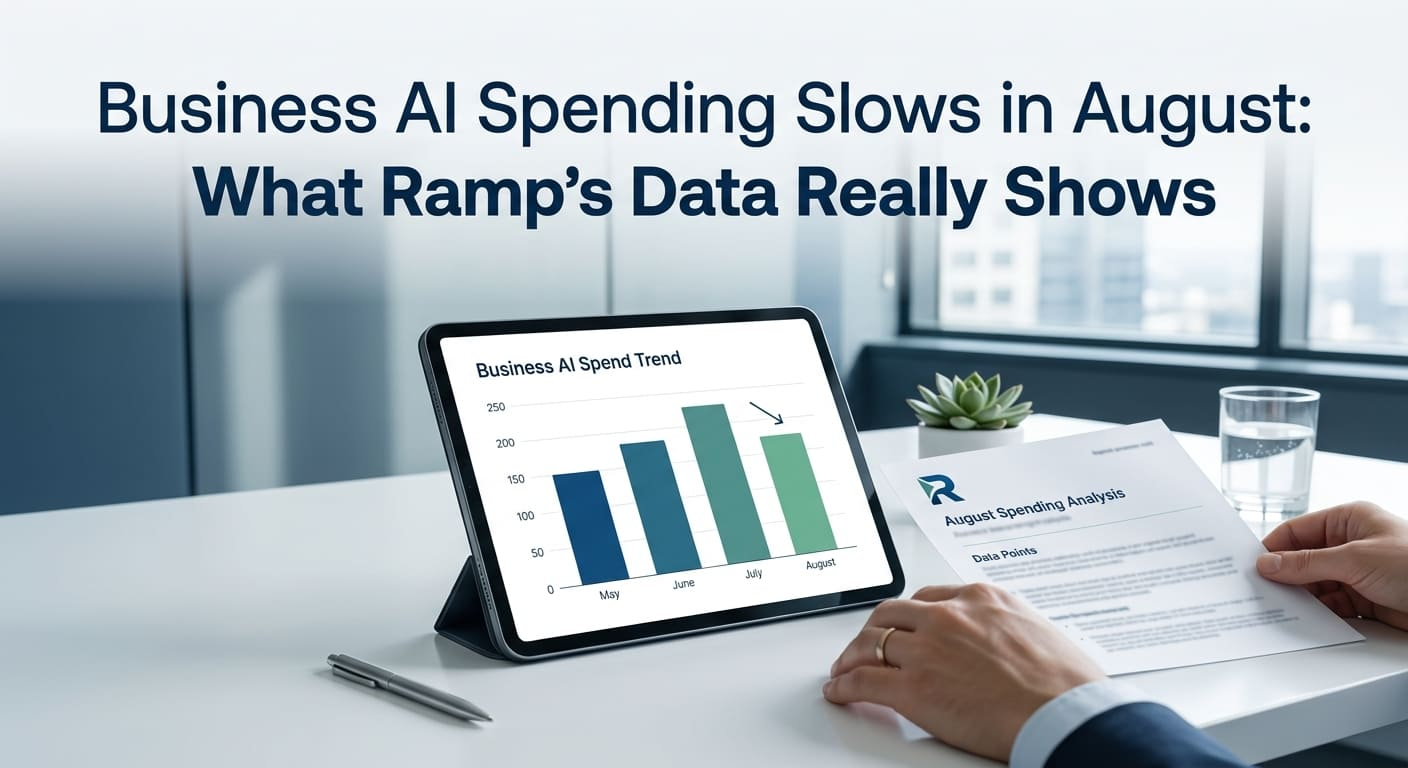
AI adoption did not stall in August. But it barely moved.
New spending data from the payments company Ramp shows that 56% of its customers paid for AI products last month. That is up just 0.4% from July. After more than a year of steep growth, a rise that small stands out.
Here is what the numbers say, why they matter, and who should actually be worried. We will define the technical parts as we go, so you do not need a background in AI to follow along.
What Ramp’s Numbers Actually Measure
Ramp is a payments company. It handles corporate cards and spending for thousands of businesses. That gives it a direct view into what companies pay for each month.
The Ramp AI index tracks that spending. It pulls data from roughly 70,000 companies and measures how many of them are actually paying for AI tools. This is not a survey of opinions. It is a record of real dollars leaving real accounts.
That matters because most AI reports rely on what people say they plan to do. Ramp’s figures show what businesses actually did with their money. Spending data is harder to fake than a survey answer.
The headline figure: 56% of Ramp customers paid for AI products in August, a rise of just 0.4% over the previous month.
Keep this in mind: a slowdown in growth is not the same as a decline. More than half of these companies are still paying for AI. They simply are not signing up in bigger numbers than before.
Why a 0.4% Change Is Worth Noticing
A small number rarely makes news. This one does, and the reason comes down to expectations.
The AI industry has been built on the assumption of fast, steady growth. Frontier labs and hyperscalers have poured staggering sums into AI infrastructure. Frontier labs are the companies building the most advanced AI models, like OpenAI and Anthropic. Hyperscalers are the giant cloud providers that run the data centers behind them.
Both groups are betting that demand will keep climbing fast enough to pay back that spending. So far, usage has grown steeply. Software engineers, in particular, adopted agentic coding tools in large numbers. Those are AI tools that can take on multi-step coding tasks on their own, not just answer a single question.
Here is the risk in plain terms. If AI tool adoption slows, the revenue that pays for all that AI infrastructure is likely to slow too. When your whole business plan depends on rapid growth, a flat month gets your attention.
The takeaway for you: watch the growth rate, not just the total. A number that stops climbing tells you more than a number that is simply high.
This Has Happened Before
One quiet month does not make a trend. Ramp’s own history proves that.
Last year, the Ramp AI index showed little to no growth in adoption between August and October. Then growth picked up again as the year closed out. The slow stretch turned out to be a pause, not a peak.
August also has a simple, human explanation. Much of the tech industry is on vacation. Fewer people at their desks means fewer people running up AI bills. That alone could account for the sleepy numbers.
So treat this month with caution before drawing big conclusions. The pattern from last year suggests a summer dip can reverse quickly.
One thing to remember: a single data point is a snapshot, not a story. Wait for the next few months before deciding what August really meant.
The Ramp Number Versus the Census Number
Ramp’s 56% figure can look alarming on its own. Put it next to a government survey, and the picture shifts.
The US Census Bureau runs its own ongoing survey of business use of AI. As of its August 23 update, just 22% of businesses reported using AI. That is less than half of Ramp’s figure.
Why the gap? Because Ramp’s customers skew techy. Companies that already use a modern payments platform tend to be more comfortable adopting new tools. So Ramp’s data may overstate how widely AI has spread across all businesses.
That does not make Ramp’s numbers useless. Far from it. It is one of the few direct spending data sets available, and it may act as a leading indicator, meaning it can hint at where the broader market is heading before slower surveys catch up.
Here is how to hold both numbers at once:
- Read Ramp’s 56% as a view of tech-forward companies.
- Read the Census Bureau’s 22% as a view of businesses overall.
- Treat the truth as somewhere between the two, depending on which businesses you care about.
Try this now: before you trust any AI adoption stat, ask one question — who was actually surveyed? The answer changes what the number means.
Falling Prices Are Quietly Reshaping the Data
The most interesting part of the report is not the adoption figure. It is what happened to spending at the biggest AI users.
Among the top 1% of firms in Ramp’s sample, AI spend per employee fell nearly 10%, dropping to $7,205. These are the heavy users the market expected to drive much of the future growth. Instead, their spending went down.
Some of that may be the vacation effect again. But Ramp economist Ara Kharazian points to a bigger force: falling token costs.
What a Token Is, in Plain Terms
A token is a small chunk of text that an AI model reads or writes. Companies pay by the token, usually priced per million. The more you use AI, the more tokens you burn, and the more you pay.
Token costs have dropped sharply. The average price fell to $0.68 per million tokens, down from a 2026 peak of $1.15 per million tokens in March. That is a steep cut in less than half a year.
OpenAI and Anthropic drove those cuts as they competed for customers. Cheaper tokens are good news if you are the one buying. But they complicate the spending data in a specific way.
Why Cheaper Prices Can Look Like a Slowdown
Here is the twist. A company can use more AI than before and still spend less money, simply because each token now costs less.
So a drop in business AI spending does not automatically mean less usage. It can mean the same usage at a lower price. The dollar figure falls even as the work stays flat or grows.
Kharazian’s read is that the labs have not yet made up for the price cuts with enough extra volume. In other words, prices dropped faster than usage rose.
The takeaway for you: lower spending is not always lower demand. When prices fall, the bill can shrink even as usage holds steady.
Companies Are Choosing Cheaper Models on Purpose
Price pressure is also changing which AI models businesses pick. Many are trading down.
Instead of reaching for the newest, most powerful releases, a lot of customers now choose older, cheaper models. Kharazian points to options like OpenAI’s ChatGPT 5.6-Terra and Anthropic’s Sonnet as examples. These models cost less and still handle most everyday tasks well.
That habit creates a problem for the labs. Employees at frontier labs have said that much of the cost of training a new model gets recouped in the first few weeks after release. If customers skip the shiny new frontier releases and stick with the older, cheaper ones, that early payback window shrinks.
Think of it like a new phone launch. If most buyers keep last year’s model because it works fine and costs less, the company selling the newest phone has a harder time earning back what it spent building it.
Pick one habit to copy: before paying for the newest AI model, test whether an older, cheaper one already does the job. Often it does.
What About Open-Weight Models?
There has been a lot of talk about open-weight models threatening the big labs. The data suggests that threat is still small.
Open-weight models are AI systems whose underlying files are shared openly, so companies can run them on their own infrastructure. To do that, businesses use model-serving or inference platforms, which are the tools that actually run a model and generate its answers.
In August, only 6.4% of AI-spending businesses used those platforms. That share is growing steadily. But it is not growing fast enough to shape the wider adoption picture yet.
So for now, the story is still mostly about the major labs and their pricing. Open-weight options are a rising side plot, not the main event.
Keep this straight: open-weight models are worth watching, but they are not yet driving what most businesses do. Focus on the mainstream tools first.
What Kharazian Thinks It Means
Ramp’s economist offers a clear way to read all of this. The slowdown is not one story. It is two, depending on where you sit.
“Competition between OpenAI and Anthropic is making AI more accessible, and also driving the price down for companies,” Kharazian said. He added that it is “not just driving the price down, but driving spend down at the top 1% of companies that previously the market was expecting to drive much of the growth going forward.”
That is a notable shift. The very customers expected to fuel future revenue are the ones spending less, mostly because prices dropped, not because they walked away.
It also helps explain a strategy move at the AI labs. They are working hard to win over non-technical users with AI co-working tools, meaning assistants built for everyday office work rather than for engineers. If growth among heavy technical users cools, reaching millions of ordinary workers becomes the next path forward.
The honest caveat: this is not a guarantee that demand is drying up. It is a sign that the source of growth may be changing.
Who Should Actually Worry
The right reaction to this news depends entirely on who you are. Kharazian put it simply: “It depends on who you are in the market. If your company is using AI, it’s great.”
Here is how the picture breaks down:
- If you build AI models or run massive AI infrastructure, softer spending is a warning worth heeding, especially with billions committed to chips.
- If you are a business using AI, falling prices and cheaper models are good news for your budget.
- If you are an everyday worker, expect more AI co-working tools aimed directly at your daily tasks.
You do not need to track every earnings report to know where you stand, in the same way you do not need to follow oil markets to notice gas got cheaper. Just ask which side of the market you are on.
Do this before you close the page: decide which group you fall into, then read every AI headline through that lens. The same fact means opposite things to a model-builder and a model-user.
Conclusion
August was a flat month for business AI spending, but the story underneath is more mixed than the headline suggests. The Ramp AI index shows adoption barely rising while heavy users spend less, largely because token costs fell from $1.15 to $0.68 per million and companies leaned on older, cheaper models like Sonnet and ChatGPT 5.6-Terra. For frontier labs and hyperscalers with enormous bets on AI infrastructure, that is a signal worth watching. For everyone actually using these tools, cheaper and more accessible AI is simply a good deal.




Be First to Comment