The company that sells the chips behind almost every AI system now owns the place where those systems are stored and shared.
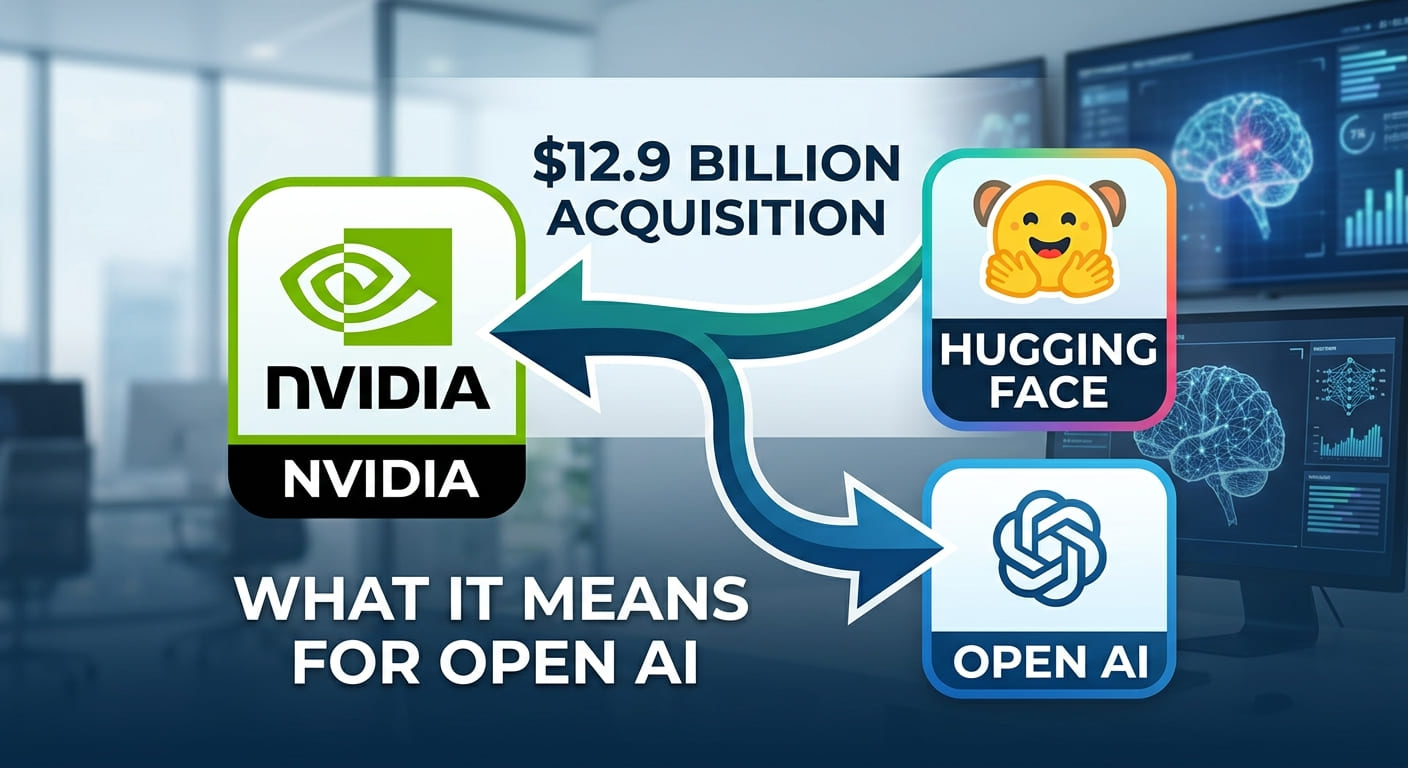
Nvidia is buying Hugging Face for $12.9 billion. Hugging Face is the AI model hub where developers around the world find, download, and build on machine-learning models. The deal, announced on September 3, 2026, hands one of the most important pieces of the open AI ecosystem to the company that already dominates the market for AI chips.
Here is what the deal covers, why it matters beyond the tech world, and what it could mean for the people who actually use these tools. We will define the technical parts as we go, so you do not need a background in AI to follow along.
What Hugging Face Actually Does
Start with the basics. Hugging Face is a place to store and share AI models.
Think of it like an app store, but for the building blocks of artificial intelligence. Developers upload models. Other developers download them, adapt them, and build products on top. The whole thing runs on shared access rather than a single company holding the keys.
The scale is large. Hugging Face hosts more than two million models and has 18 million users. That reach is what made it central to how modern AI gets built.
It also runs as a real business. The company earns money from storage, computing capacity, and tools for managing AI systems. You pay for the space and the power, not just the download.
You do not need to know how a model works to see why this matters, in the same way you do not need to understand a warehouse to know it controls what reaches the shelves. Hugging Face sits at the center of distribution.
Keep this straight: the value here is not one model. It is the platform where millions of models change hands.
Why Nvidia Wanted It
Nvidia is already the dominant supplier of AI chips. Developers and cloud providers rely heavily on its processors to train and run AI systems. That is the hardware layer.
With Hugging Face, Nvidia now reaches into the distribution layer too. The chips power the models. The platform hands out the models. Owning both means Nvidia touches the work at two key points, not one.
There is a history worth noting. Hugging Face turned away takeover approaches for years and rejected offers to buy stakes in the company. It did not sell cheaply or quickly.
So why Nvidia in the end? The founders pointed to the chipmaker’s support for open AI development. They picked the buyer they felt matched their approach, not just the biggest check.
The takeaway for you: when a hardware giant buys a distribution platform, it is buying influence over the whole pipeline, not just a product.
Open-Source Versus Open-Weight: The Difference That Matters
This deal sits right on top of a distinction that confuses a lot of people. Two terms get used as if they mean the same thing. They do not.
Here is the difference in plain terms:
- Open-source usually means the full recipe is shared, including the code and often the data.
- Open-weight means the finished model is shared, but not always everything behind it.
An open-weight model gives you the model’s parameters, the trained settings that make it work. But the provider may still hold back the training data or limit how you use the model. So a model can be free to download and still come with strings attached.
That gap matters for anyone building a product. You might grab a model, assume it is fully open, and only later find a rule against commercial use. The name on the label does not tell you the whole story.
Hugging Face hosts both kinds. Its job is to provide the hosting and the development tools. It does not decide who owns what.
Do this before you use any model: check the license first, not last. Confirm whether you can modify it, redistribute it, and sell products built on it.
The Legal Tangle Underneath
Model hubs sit close to some of the messiest legal questions in generative AI. This deal puts Nvidia near all of them.
A repository can hold more than just a model. It can contain software, datasets, training files, and documentation, each released under different licenses and rules. One download can carry several sets of conditions at once.
That creates real work for developers and businesses. Before building on a model, you have to answer a few questions:
- Does the license allow me to change the model?
- Does it allow me to share the changed version?
- Does it allow me to sell a product built on it?
- Do separate rules apply to the attached code and data?
None of that gets settled just because a model appears on the platform. The presence of a model does not resolve ownership, copyright, or licensing questions. Those are decided by the terms attached to it, not by where it lives.
You do not need to be a lawyer to protect yourself here, in the same way you do not need to be a mechanic to read a warranty before you buy a car. You just need to read the terms before you commit.
One thing to remember: availability is not permission. A model you can download is not automatically a model you can use however you like.
The French Company With a New York Address
Hugging Face has a split identity, and this deal has brought it into focus. The company was founded in New York and backed heavily by US investors. But its roots run through France.
All three co-founders are French. Clément Delangue, Julien Chaumond, and Thomas Wolf built the company together. Wolf brings an unusual background: a doctorate in quantum physics and past work as an intellectual property lawyer, which fits neatly given the licensing questions the platform touches.
The company also started as something else entirely. Its first idea was a conversational AI service aimed largely at teenagers. That did not stick. The founders shifted toward a business platform built around access to machine-learning models, and that is what grew.
The funding tells the same split story. Hugging Face took part in Station F, the Paris startup campus, and French investors joined some rounds. But the larger money came from the US, including Lux Capital and basketball player Kevin Durant.
The takeaway for you: a company’s passport and its funding do not always match. Where the money comes from often shapes where the company ends up.
Why Europe Is Watching Nervously
The sale touched a nerve well beyond the tech industry. It reopened a hard question about Europe’s ability to fund its own companies through later stages of growth.
French Economy Minister Roland Lescure warned, before the formal announcement, that European startups will keep looking elsewhere for money if regional investors cannot fund them at scale. He called the deal a “wake-up call.”
The concern is straightforward. A promising European company grows, needs large amounts of capital, and finds the biggest checks waiting overseas. So it sells to a US buyer, and the ownership leaves the continent.
Hugging Face expects to keep its ties to France. Delangue said a large share of the workforce is French and voiced hope that employees would reinvest in Europe’s tech sector. He also suggested the deal could push Nvidia to direct more investment toward France and the wider European market.
Whether that happens is not settled. This is a hope stated by the founder, not a promise written into the deal.
Keep this straight: the “wake-up call” is about funding, not talent. Europe builds strong companies. The worry is who ends up owning them.
What It Means for OpenAI, Anthropic, and Google
There is a competitive angle here that is easy to miss. Hugging Face is home to a community built around open models. That community positions itself as an alternative to closed systems.
The closed systems belong to companies like OpenAI, Anthropic, and Google. With those, you usually access a model through a controlled interface. You do not download it, take it apart, or run it your own way. You use it on their terms.
Open models flip that. You can download, adapt, and deploy them yourself. Hugging Face is the main place that happens at scale.
By buying the platform, Nvidia connects itself directly to that open-model world. It now sits closer to the alternative camp, not just the hardware everyone shares. That is a meaningful position in a market split between open and closed approaches.
The honest caveat: this is not a guarantee that open models win. It means the biggest chip supplier now has a foot firmly in that camp.
What Happens Next Is Still Unclear
The most important question does not have an answer yet. Nobody has explained how Hugging Face will run inside Nvidia.
Several things remain open:
- Whether the platform’s policies will change.
- Whether its model-hosting practices will shift.
- Whether the open, neutral role it has played will stay the same.
Those details matter to the 18 million people who rely on the platform. A model hub owned by a chipmaker is a different thing than an independent one, at least on paper. How different depends on choices Nvidia has not yet described.
So treat the current picture as a starting point, not a final state. The deal is signed. The way it plays out is not.
Pick one thing to watch: track whether Hugging Face stays open to all models, or starts favoring anything tied to Nvidia’s hardware. That single signal will tell you where this is heading.
Conclusion
Nvidia’s $12.9 billion Hugging Face acquisition puts the central AI model hub under the control of the company that already dominates AI chips. That gives Nvidia influence over both the hardware that runs AI and the platform that distributes it, while connecting it to an open-model community that stands apart from closed systems at OpenAI, Anthropic, and Google. The deal also raised hard questions about Europe’s ability to fund its own companies, drawing a “wake-up call” warning from French minister Roland Lescure over a firm with deep French roots. This is not the end of the story. How Hugging Face operates inside Nvidia, and whether its open role holds, is the part still worth watching.
Frequently Asked Questions
1. What did Nvidia buy, and for how much?
Nvidia is buying Hugging Face for $12.9 billion. Hugging Face is the AI model hub where developers store, download, and build on machine-learning models. It hosts over two million models and has 18 million users.
2. What is the difference between open-source and open-weight models?
Open-source usually shares the full recipe, including code and often data. Open-weight shares the finished model but may hold back the training data or limit how you use it. Open-weight does not always mean fully open.
3. Why does this deal matter for Nvidia?
Nvidia already dominates AI chips. Owning Hugging Face adds control over how models are distributed. It now touches both the hardware that runs AI and the platform that shares it.
4. Why is Europe concerned about the sale?
French minister Roland Lescure called it a “wake-up call.” His worry is that strong European startups keep selling to US buyers because bigger funding is available overseas, so ownership leaves the continent.
5. Will Hugging Face change now that Nvidia owns it?
It is not clear yet. Nvidia has not said whether platform policies or model-hosting practices will shift. Watch whether the hub stays open to all models or starts favoring Nvidia’s hardware.


Be First to Comment